
11 November 2025: when workers took the streets
In this powerful intervention, Hamid Taqvaee reflects on the historic march of more than 3,000 South Pars refinery workers and situates it within the broader Woman, Life, Freedom revolution and the nationwide struggle over livelihoods and dignity. From the strategic demand to abolish contractors to the shared calls against executions and for political freedom, the text shows how workers’ struggles have become the beating heart of today’s revolutionary movement. It also honours the life and legacy of Mansour Karimi, whose funeral—marked by The Internationale—became itself an act of resistance. A text about organisation, continuity, and the working class at the centre of history.
Workers in the arena – Remember this day
Hamid Taqvaee— 19 November 2025
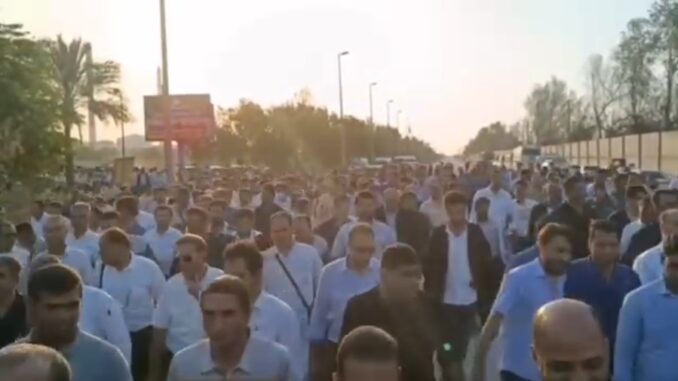
The magnificent march of more than three thousand workers from the South Pars gas complex refineries on 11 November 2025 marks a high point in workers’ struggles. This demonstration—whose video circulated on social media under the title “The splendour of unity among South Pars workers”—brings to mind the mass and powerful protest marches of workers at the heart of the great revolutions of modern history in Iran and elsewhere. Specifically, since the 1979 revolution, Iran’s streets have not witnessed such a glorious march.
This action was not a bolt from the blue. Ten days before the South Pars workers’ march, two thousand contract workers gathered in Tehran in front of the presidential office, chanting “Tanks, cannons, firecrackers—contractors must be eliminated” and “We don’t want contractors, we don’t want contractors.” This gathering itself emerged as a continuation of the protests and marches of employed and retired workers over the past year.
At the heart of the Woman, Life, Freedom movement—and particularly over the past year—various sections of workers, pensioners and nurses, especially in the oil and petrochemical industries, have represented the protest of the entire society risen up against poverty and economic insecurity through their continuous demonstrations, rallies and marches under the banner “Unity, unity against poverty and corruption.” Slogans of these struggles such as “Enriching life is our inalienable right” and “Water, electricity, life are our inalienable rights” express the deepest sentiments of the vast masses driven below the poverty line. But workers’ struggles go beyond this level. The demand for the abolition of the death penalty and the freedom of political prisoners are two broad and shared demands across all protest actions and gatherings of workers and pensioners, the Tuesdays against executions, and other protest movements in society. The demand to eliminate contractors—which challenges a pillar of the ruling mafia economy—is in fact a strategic slogan against the entire contemporary capitalist system in Iran and elsewhere.
The ongoing workers’ movement against the unbearable livelihood conditions imposed on the working masses driven below the poverty line in Iran is not spontaneous or accidental; it is organised and the result of conscious effort. Thousands of advanced, anti-capitalist and socialist workers are active within this movement, preparing and organising the struggles. The protest councils of Arkan-e Sales workers, contract oil workers, and nurses are examples of organised activist structures within the movement against disastrous livelihood conditions.
Another event on 11 November this year was the death of Mansour Karimi, a veteran socialist and communist, and a militant in the workers’ movement and the Woman, Life, Freedom movement. At the same time as the magnificent march of oil workers, he lost his life in Towhid Hospital in Sanandaj due to the negligence and irresponsibility of the Islamic Republic’s medical system, becoming a victim of the regime’s silent killings. But his death did not remain silent. His passing led to a powerful and unprecedented gathering of the outraged people of Sanandaj. At his funeral, more than a thousand people participated while singing The Internationale, honouring his memory with forceful speeches against the Islamic capitalist system. Not only the people of Kurdistan, but activists, forces and organisations in the workers’ movement and protest movements across Iran commemorated a dear comrade—one who had stood with them—through statements and messages of condolence. A comrade who was a beloved and well-known figure among the people of Kurdistan; an activist in the workers’ movement; a member of the board of the Free Union of Workers of Iran; an activist in the Red May Day events of Sanandaj; an organiser of the Snowman Festivals in defence of children’s rights; an activist in the justice-seeking movement, against executions and for the freedom of political prisoners; in the women’s movement; in the movement to defend the environment; and in dozens of other arenas of struggle long before the emergence of the Woman, Life, Freedom movement—and within that movement itself.
We lost dear Mansour, but tens, hundreds and thousands of socialist militant workers like him are organising and advancing not only the workers’ movement and mass marches such as the South Pars refinery workers’ march, but also the ranks of all the people enraged by the Islamic capitalist mafia state, and are active in the revolutionary movement ignited by the killing of Jina Mahsa Amini.
The Internationale sung at the funeral of Mansour Karimi under the blades of Islamic executioners is also the anthem of the magnificent march of the South Pars workers.
19 November 2025
AI-assisted translation, from the original Farsi
Be the first to comment