
Why socialism is back at the centre of Iran’s future
In this wide-ranging interview, Hamid Taqvaee explains why the current political moment makes the socialist alternative not just relevant, but urgent. From the structural barbarism of capitalism in Iran to the failures of monarchist, nationalist and Islamist “transition” projects, he argues that Woman, Life, Freedom is a left-wing revolution that demands a socialist horizon. The text tackles hard questions head-on: wealth and plunder, sanctions and dictatorship, Saudi Arabia myths, and whether global capitalism would tolerate a socialist Iran. A clear, strategic defence of socialism as the only humane way out of Iran’s crises.
Hamid Taqavee — 22 November 2025
Capitalist barbarism and the horizon of socialism in Iran
International: At its 60th Plenum, the Party placed a clear emphasis on socialism as the future alternative to the Islamic regime through the publication of the resolution “The possibility, desirability and urgency of socialism in Iran” and the statement “Socialism or barbarism!” Neither the economic hardships and calamities under the rule of the regime are new, nor is the Worker-communist Party’s commitment to a socialist republic based on people’s councils. Given this, what makes it necessary to raise this discussion at this particular moment?
Hamid Taqvaee: Yes, neither the calamities facing society are new nor the Party’s programme and policies. What is new, however, is the political situation. In the present political conditions, the discourse on the transition period and the future of society has been pushed forward more than ever before and has become the subject of debate and discussion among various political forces and even factions within the ruling establishment. This situation itself is the result of the regime’s unprecedented weakness in the region and within society, and of the mega-crises for which there is no solution other than the overthrow and complete dismantling of the entire Islamic Republic system. Under such conditions, it is more necessary than ever to place the socialist horizon before society and to present the Party’s policies for the transition period and beyond.
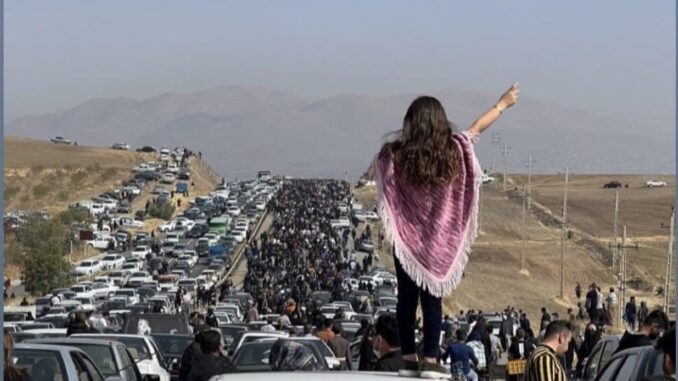
Today monarchists, national and ethnic republicans—both centralist and federalist—are each putting forward their own programmes for the transition period and Iran’s future. Anti-Khamenei and anti-“clerical regime” Islamists, from the Mojahedin to Mousavi and various strands of so-called “regime-overthrowist” reformists, are another active force in this arena. The Woman, Life, Freedom movement is represented by none of these three currents. The overthrow movement that raised the banner of Woman, Life, Freedom after the killing of Mahsa Jina Amini is left-wing and radical in its slogans, content and objectives, and it calls organised left forces and revolutionary communists and socialists—such as our Party—into the arena. For this reason, not only in our engagement with other political forces but, more importantly, in relation to society and the social left that has actively entered the field, it is necessary for us to place the socialist alternative ever more centrally in our discursive and practical activity. The documents of our Party’s 60th Plenum are a step in this direction.
International: Parts of these documents state that, for specific reasons, capitalism in Iran cannot be profitable. At the same time, they refer to the “success” of the leaders of the Islamic Republic in large-scale theft and plunder. Is this not a contradiction? Moreover, the same documents point to Iran’s vast geographical wealth. Why, relying on this wealth, can Iran not become—within the framework of capitalism—an economically successful country, for example similar to Saudi Arabia?
Hamid Taqvaee: Regarding the first part of your question, I should say that the basis of the regime’s astronomical wealth accumulation and that of the economic mafia linked to it is rent-seeking, the smuggling economy, theft, and the plunder of society’s natural wealth—such as mines, forests, oil and water resources, and so on. As a clear example, it is evident that the wealth of an institution such as Astan Quds Razavi—often described as the largest cartel in the Middle East—has not been generated through productive activity. Drug trafficking from Afghanistan to Europe is one of the sources of its massive wealth accumulation, which is why people quite rightly refer to it as Astan-e Dozd Razavi (the “Razavi Shrine of Thieves”). Other institutions dominating Iran’s economy—such as the Office of the Supreme Leader, the IRGC, Jihad organisations, the Foundation of the Oppressed, and so on—are of the same nature.
Clause four of the resolution “The possibility, desirability and urgency of socialism in Iran” explains this as follows:
“Capitalism in the Islamic Republic serves the interests of a tiny minority that has amassed astronomical wealth through government rent, embezzlement, theft and plunder. This predatory minority, in the form of mafia gangs such as the Office of the Supreme Leader, the IRGC and Basij, the Foundation of the Oppressed, the Execution of Imam Khomeini’s Order Headquarters, Astan Quds Razavi, and others, controls the vast majority of capital and wealth resources, including real estate, mines, forests, water and land, exports and imports, and productive, commercial and service centres. Many other sectors of capital are also directly or indirectly linked to these gangs and government centres and can operate and generate profits only on this basis.”
These conditions are themselves imposed on the backdrop of sanctions and the political isolation of the Islamic Republic, arising from the regime’s identity-based and strategic hostility to the West. In fact, the term “sanctions profiteers,” which regime officials themselves use, accurately describes all the mafia gangs ruling Iran. This situation can only be changed through the overthrow of the regime and the dismantling of the entire existing system.
As for the second part of your question, the issue for Iranian capitalism is not resources or raw materials. Iran is a wealthy country in this respect. Rather, as explained in the resolution, the problem is that “historically, capitalism in Iran has lagged far behind the industrialised world in terms of capital accumulation, technology, the organic composition of capital, productivity of labour, and so on, and is therefore compelled, in order to compete and be profitable on the global stage—especially today, when capital has taken on an unprecedentedly global character—to compensate for its backwardness through intense exploitation.” Capitalism in Saudi Arabia has exactly the same characteristics. Good relations with the West—such as those we see today in Saudi Arabia, and as existed under the Shah’s dictatorship—do not alter the nakedly dictatorial and repressive nature of these regimes.
The opposition under the Shah believed that independence from the United States would lead to democracy, and today’s opposition imagines that ending hostility towards the US will produce democracy. Both are mistaken. Reality, just as it invalidated anti-American “democracy-seeking,” will also expose the emptiness of US-backed “democracy-seeking.” The very continuity of dictatorship—from Reza Khan to the present—shows that the issue is not relations with the West, but is rooted in the very nature of Iran’s capitalist system. To achieve freedom in Iran, even at the level of Western democracies, production for profit must be abolished.
International: Another issue concerns the obstacles to implementing a socialism of this kind in Iran—political obstacles, not economic ones. Would the capitalist world allow such an experiment to be realised in Iran, given its geopolitical importance—an experiment that could fundamentally transform the entire region? Would they not conspire against it?
Hamid Taqvaee: Politically and socially, we rely on freedom-loving people and on left and progressive institutions, organisations and parties around the world. A socialist republic in Iran would mean a system that, from day one, abolishes the death penalty; puts corrupt and criminal officials of the former regime—many of whom have been accused of crimes against humanity by international bodies—on trial; separates religion from the state, the law and the education system; places free healthcare, free education and other welfare services at the centre of its agenda; turns the prohibition of all forms of discrimination into law; guarantees unconditional freedoms; opens the doors of society and invites all global media and people to visit the socialist republic of Iran and report freely; and so on.
Such transformations would be welcomed by broad sections of people in the region and the world. Governments, parties and political forces—if only to secure votes and maintain their own positions—would not be able to easily attack such a system. Recently, even in New York City, at the heart of US capitalism, we witnessed the election of a person who openly identifies as a socialist. The same happened in Seattle. American billionaires spared no effort in trying to defeat them, yet they failed. The reason was nothing other than the social base, popularity and public support these candidates enjoyed in New York and Seattle. All the more so in a society that has overthrown the Islamic Republic through the power of a modern, left-wing revolution and has placed on its agenda measures far more comprehensive and humane—and far more attractive to public opinion—than the promises of self-proclaimed socialist mayors in the United States, socialists would not be easily defeated.
It should also be borne in mind that a socialist revolution in Iran would dismantle the apparatus of political Islam and Islamic terrorism in the region and the world. This, in turn, would be a major factor in global popularity and in attracting the support of the masses of people in the world and the region, as well as secular and anti–Islamic-terrorism parties and institutions worldwide, for a socialist republic in tomorrow’s Iran.
22 November 2025
AI-assisted translation, from the original Farsi
Be the first to comment