
In this sharp intervention, Hamid Taqvaee contrasts two very different “calls” issued during the protests of 18 Dey. While one sought to retroactively claim ownership of a movement already unfolding in the streets, the other—issued by political parties—led to an unprecedented and genuinely organised strike across Kurdistan and other Kurdish regions, involving 50 cities and even political prisoners. The text exposes how sections of the opposition media distorted these events, turning real collective action into a manufactured leadership narrative, and argues that defending the unity and direction of the uprising requires confronting political appropriation head-on.
Two calls and one controversy
9 January 2026
On Thursday, 8 January 2026, developments took shape in the course of the people’s uprising that are illuminating and revealing of the realities and conditions of today’s ongoing protests and struggles. Two calls had been issued for this day. One was a call by Reza Pahlavi for people to continue doing what they were already doing—namely, to come out onto the streets and chant slogans.
This was not in fact a call, but rather an attempt to appropriate and register the people’s movement in his own name. For two weeks prior to this—since this new wave of the movement began with the strike of Tehran’s bazaar merchants—people had been coming out onto the streets every day in ever larger numbers, and these demonstrations have continued to expand daily. Issuing a “call” for what people are already actively doing is not a call at all; it is an attempt to fabricate a track record for oneself.
The other call was a call for a strike in Kurdistan. This second call was issued by political parties—specifically by two nationwide parties and seven Kurdish organisations and Kurdish branches of parties. The two nationwide parties were the Communist Party of Iran and the Worker-communist Party of Iran. The Kurdish organisations included the Kurdistan Democratic Party, Komala – Kurdistan Organisation of the Communist Party of Iran, Komala of the Toiling People of Kurdistan, Komala of the Revolutionary Toilers of Kurdistan of Iran, the Kurdistan Freedom Party, the Party for a Free Life of Kurdistan (PJAK), and the Khabat Organisation of Kurdistan of Iran.
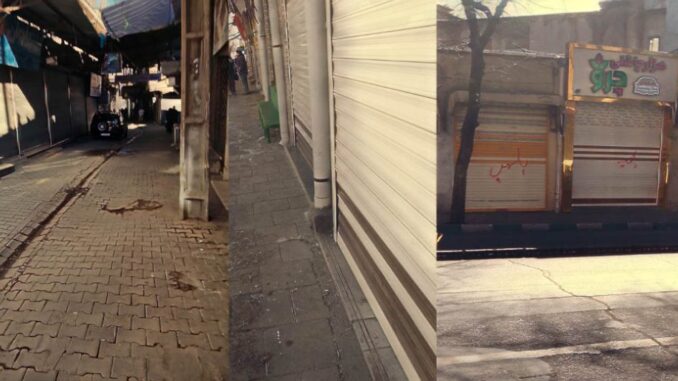
This call by the parties was met with unprecedented support and success. In around 20 cities in Kurdistan, all shops and bazaars were closed. In addition, strikes took place in cities in Kurdish regions and provinces—namely Kermanshah, Ilam, and West Azerbaijan—where strikers declared that they were striking in response to the call and in solidarity with the Kurdistan strike. Another unprecedented development was the hunger strike by a number of political prisoners in prisons in Kurdistan and in prisons in other cities across Iran, declared in support of the Kurdistan strike. According to reports by Hengaw and IranWire, these strikes encompassed a total of 50 cities in Kurdistan and other Kurdish regions. This was, in reality, a new advance in the course of the people’s struggles—one that would not have occurred without the parties’ call.
At the very least, one would have expected honest media outlets that claim to support the people’s protests to reflect these realities as they actually occurred. But it seems such an expectation from television channels and opposition media inclined towards Reza Pahlavi is entirely misplaced. Their entire effort has been to present an unreal picture to society, suggesting that the demonstrations of 18 Dey took place in response to Reza Pahlavi’s call and that the people had accepted his leadership, and so on.
It is clear that every party and political force has the right to put forward its own aims and policies and to ask its supporters to bring its slogans into the streets. But appropriating the people’s protests is no longer the promotion of a political line—it is political charlatanism. Media outlets that fuel this charlatanism likewise show no trace of journalistic integrity or honesty. In these media, news of the unified strike in 50 cities in the western provinces of the country—the most extensive nationwide strike in the history of the Islamic Republic—was treated as a marginal issue, while, through hype and fabrication, the ongoing popular demonstrations—now two weeks old and expanding daily—were credited to Pahlavi. This is a blatant ignoring and distortion of reality.
The cause of the people risen up in Iran, and the goal of the ongoing protests and strikes, is the overthrow of the Islamic Republic. This movement must be strengthened and unified as much as possible, and precisely for this reason, the efforts of any current that seeks to create division within the struggle against the Islamic Republic by appropriating the people’s protest actions in its own name must be persistently exposed and neutralised. Forces that are honest and loyal to the revolution and to its just and humane aims must stand decisively against these efforts and place united struggle against the Islamic Republic at the centre of their activity.
Hamid Taqvaee
9 January 2026
AI-assisted translation, from the original Farsi
Be the first to comment