
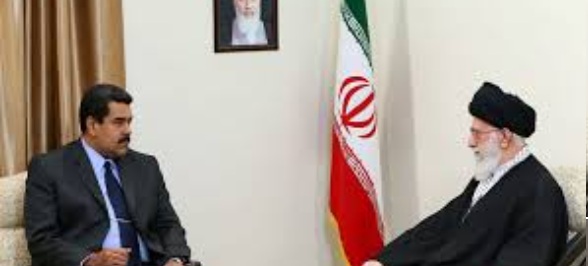
In this intervention, Hamid Taqvaee cuts through the false “democracy versus dictatorship” narrative surrounding the removal of Nicolás Maduro. He argues that what unfolded in Venezuela was not a victory for democracy but a confrontation between two reactionary forces: US imperial militarism on one side and a repressive, corrupt dictatorship on the other. While exposing Washington’s real motives, the text also lays bare Maduro’s record of repression, corruption, and alliance with the Islamic Republic. The article situates Venezuela’s crisis within a wider global context—and explains why Maduro’s fall is also a strategic blow to political Islam and the Iranian regime.
Venezuela: a confrontation between two reactionary forces
Hamid Taqvaee
4 January 2026
The removal of Maduro, the president of Venezuela, through a US military attack marks the beginning of a new phase of domination by the US state through military intervention in the “backyard” of Latin America. Contrary to the claims of the Trump administration, this attack was neither carried out in defence of democracy nor even to confront drug cartels. This reality is so obvious that Kamala Harris, left-wing US senators such as Bernie Sanders and Alexandria Ocasio-Cortez, and even Republican representative Marjorie Taylor Greene have stated that the military attack on Venezuela has nothing to do with defending democracy or fighting drug cartels; rather, Trump’s objective is control over Venezuela’s oil resources and “playing a powerful role in the region.”
However, whatever the aims and motivations of the US government may be, they do not change the fact that the Maduro government was a repressive regime with virtually no social base. Through engineered elections—similar to those of the Islamic Republic—disqualifying opponents, manipulating ballot boxes and committing fraud, he served three presidential terms. According to United Nations reports, more than 9,000 extrajudicial killings took place during his rule, and around five million people were forced to leave the country. While Venezuela has been gripped by a severe economic crisis, inflation, rising prices and widespread misery, Maduro and his family accumulated astronomical wealth—one example being $700 million held in Western banks, which was seized by the US government. Internationally, the Maduro government aligned itself with the camp of the Islamic Republic, Russia and China. Maduro referred to Khamenei as “a wise leader” and to Raisi as his “elder brother,” and was a supporter and strategic ally of the Islamic Republic. Under Maduro, Venezuela became a safe haven for the Islamic Republic’s investments and a base for the influence of political Islam in the region.
For this reason, there is no “black and white” or “good versus evil” in the attack on Venezuela. Trump does not represent democracy, nor was Maduro left-wing or democratic. What we are witnessing is a confrontation between a fascistic superpower and a criminal dictatorship. If Maduro had enjoyed even a minimal degree of popular legitimacy or support, the US government would not have been able so easily to detain him and his wife in a quasi-coup-style attack and remove them from the country. Maduro’s removal, like the removal of Bashar al-Assad, represents a clash between two reactionary forces. Whatever the objectives of the US government may be, they do not alter the fact that a repressive dictatorship with blood on its hands has been removed—and from this perspective, this development can provide favourable conditions for the active presence and expansion of left-wing and freedom-seeking forces in that country.
As far as Iran’s political conditions are concerned, Maduro’s removal is also a blow to the Islamic Republic, which sought to use Venezuela as a base for political Islam in Latin America, as an investment market for billionaire ayatollahs, and even as a safe country and refuge for the day after its own overthrow. From this perspective, the fall of Maduro—like the fall of Bashar al-Assad—makes the path toward the overthrow of the Islamic Republic by the power of the Iranian people’s revolution more open.
Hamid Taqvaee
4 January 2026
AI-assisted translation, from the original Farsi
Be the first to comment