The people’s answer to the war: the overthrow of the Iranian Regime – New Channel TV interview with Hamid Taqvaee, leader of the Worker-communist Party of Iran
28 February 2026
Transcript of the video below.
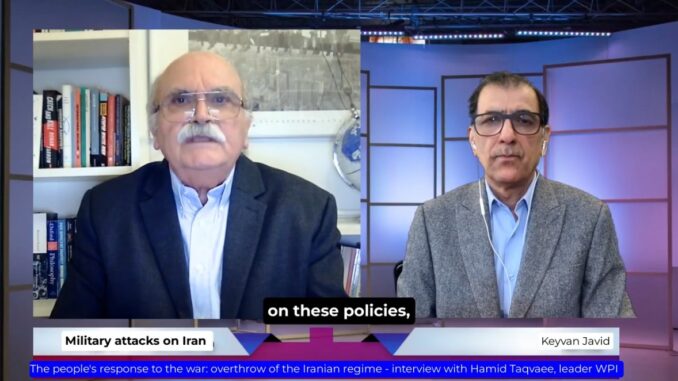
Keyvan Javid: Please accept my warm greetings. I am Keyvan Javid, and you are watching a special programme about the war in Iran. Today, Hamid Taqvaee, the leader of the Worker-communist Party, is with us to answer a few of our questions. Hamid Taqvaee, under what circumstances and for what reasons has this war arisen, and in what conditions is it taking place?
Hamid Taqvaee: There is a famous saying that war is the continuation of politics. The question is, what kind of politics has led to this war? I think everyone knows the answer to this. The regional and domestic terrorist policies of the Islamic Republic, its nuclear enrichment, its nuclear project, ballistic missiles, and its support for regional terrorist forces. These are the reasons upon which the war has been based. These reasons have also been discussed in the negotiations between the US and Israel regarding the Islamic Republic. They wanted the regime to abandon these actions and policies, but because they are of identity-based importance to the regime, it cannot do so. It is a matter of identity. It is a strategic matter for the Islamic Republic. This is a regime of terror and executions in Iran and the region, and therefore abandoning these policies, from the regime’s perspective, means losing all the identity, credibility, and legitimacy it has built within the political Islamic movement and among its own forces. For this reason, it did not surrender, and this war broke out. The issue now is that as long as the Islamic Republic insists on these policies, not only will this war continue, but it will also lead to multiple wars. A warlike atmosphere will dominate the region, and the fundamental issue is the very existence of the Islamic Republic. Yes,
Keyvan Javid: Why is the Islamic Republic unwilling to yield under these circumstances to a full-scale war with what is considered the world’s largest army? On the other hand, what is it about Israel that the Islamic Republic is willing to go to war but not yield to demands regarding its so-called nuclear or ballistic missile programmes and such?
Hamid Taqvaee: Because it knows that yielding to those policies specifically means crossing Khamenei. If we want to bring the discussion very clearly to its practical outcomes, it means that the line and strategy Khamenei has pursued throughout his tenure must now be abandoned. That would be a blow to the prestige, identity, and political position of the Islamic Republic, not only in the region but also within Iran itself. Any retreat from those policies would be a green light to society to rise up and overthrow the government. It would lose its legitimacy. This essentially means empowering factions like Mousavi and Rouhani, who have long been sidelined and criticised by this regime, which has insisted on being anti-Israel and anti-America. Death to Israel. Death to America. These slogans are the identity and existence of the Islamic Republic. Abandoning them means the Islamic Republic would have to change so fundamentally that it would lead to its downfall. This is something that Khamenei’s faction, in particular, fully understands. Yes, it knows that war will bring it blows, but it calculates that if it can survive this war, for instance, if Khamenei remains alive and it ends after a few weeks or months, then it could even claim victory and further suppress the people. This is the perspective it has. Whereas any retreat under these conditions would mean that the people would rise up against it and not allow it to remain in power.
Keyvan Javid: Two lines of thought. One line, not particularly strong, is that we condemn any attack on Iran. We condemn any attack on the territorial integrity of Iran. And another part says no, we do not condemn it. It says that these are the conditions that must exist. The war is the result of the Islamic Republic’s own actions. What is your opinion?
Hamid Taqvaee: Well, naturally, you see, this line that says we condemn the attack on Iran and its territorial integrity, etc., well, it is a nationalist line and, I can say, an apolitical ideological line because there is also a part of the left that says since they are imperialists, since Israel itself is responsible for massacres in Gaza, etc., its attack on Iran is condemnable. This is not our policy. It was not our policy during the twelve-day war. It is not our policy today. We do not condemn this war where it directly strikes the government, its officials, its security forces, its military forces, and the centres upon which the government’s power depends. We do not condemn this. Not only do we not condemn it. We think it can, it can benefit the people’s struggles. It can weaken the regime in the face of the people’s revolution. But wherever this war causes destruction to people’s homes, devastation, the killing of ordinary people in society, those operations, those attacks are condemnable. In our view, the correct and realistic policy is this. Attack. In my opinion, no attack by any government on the Islamic Republic, on its governmental centres, and its security and military forces is condemnable. Because the Islamic Republic, in its war against the people, has shown the utmost savagery and criminality, and any blow to this regime is welcomed by the people. But the people must use this situation to completely end this warlike atmosphere and the Islamic Republic altogether. In any case, in my opinion, this war must very clearly have its attacks condemned wherever they harm and damage the people. But attacks on governmental centres should not be condemned.
Keyvan Javid: What should the people do in these circumstances?
Hamid Taqvaee: The first story is why this war started and what should be done in response to it. Because, you know, war puts issues under a cloud of confusion. For instance, the issue of political prisoners’ freedom was being raised. People were coming out, students were taking to the streets. They were gathering in university campuses. During the 40-day mourning ceremonies, chants of ‘Death to the Islamic Republic’ were being heard. Chants like ‘I will kill, I will kill the one who killed my brother’ were being shouted, and so on. These were the slogans. Now all of these have been overshadowed by the war. So, how should people assert their will in this situation? In my opinion, the first issue is that the Islamic Republic must be told to surrender. It must be told to abandon these terrorist and anti-human policies. It must accept these conditions. So that this war can come to an end. The fact that this issue politically weakens the government is exactly what the people want. Yes, yes, you must abandon the nuclear project. You must give up your regional Islamic terrorist claims. Because it paves the way for us to overthrow you and bring you down. So, the first demand in wartime conditions seems to be that the Islamic Republic must end the war by accepting these conditions. These conditions are what the people also desire. This is the first point.
The second point is that to the extent that the regime’s security and military forces, and its decision-making centres, are weakened, it can potentially open the way for people’s attacks, for people’s offensives. People must stop working from today. Society must be paralysed. The Islamic Republic is now closing universities and schools. Then workplaces, courts, shops, all of these must be shut down. Society must be brought to a standstill. In wartime conditions, this not only makes people safer because activities and movements are halted, but it also deals a blow to the Islamic Republic. But beyond that, these conditions can be used. Alongside the weakening of the regime’s forces, offensives can be launched. Such as attacks on government centres, people’s attacks, people taking to the streets, taking over radio and television stations, and generally people’s offensives to deliver the final blow to this regime and bring it down. It is entirely conceivable that in the midst of wartime conditions, a widespread uprising could take shape. History is full of instances where uprisings and revolutions have emerged during wars.
But in any case, whatever the conditions may be and whichever direction they go, we are committed to the overthrow of the Islamic Republic and fighting for its downfall with all available means. In these conditions, the goal must not be lost. The goal cannot be condemning Israel and America on one side and condemning the Islamic Republic on the other. These positions are not the answer. The answer is that even in wartime conditions, we must target our main enemy. And this war has been created by this very enemy, and even if someone wants peace, if someone wants the war to end, they must fight with all their might for the overthrow of the Islamic Republic.
Keyvan Javid: Thank you very much, Hamid Taqvaee, for being with us. Dear viewers, we had a conversation with the leader of the Worker-communist Party of Iran, Hamid Taqvaee. Wishing you all the best.