
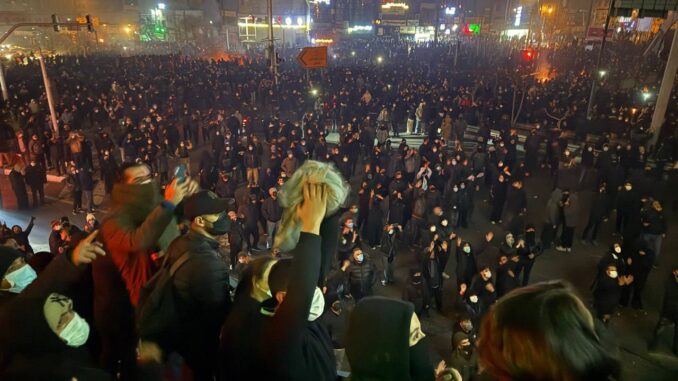
As street protests, strikes, and mass mobilisations once again spread across Iran, this new wave is not merely a continuation of past unrest—it marks a decisive class polarisation within the revolution. In this powerful analysis, Hamid Taqvaee explains how the Woman, Life, Freedom movement is entering a sharper phase, confronting not only the Islamic Republic but also a reactionary current within the opposition itself.
The article exposes how monarchism today functions as Iranian Trumpism: intolerant of dissent, hostile to revolutionary figures, and aligned—openly or indirectly—with repression. From attacks on activists like Narges Mohammadi and Toomaj Salehi, to attempts at leader-worship around Reza Pahlavi, this current reveals itself as a fifth column against genuine revolutionary change.
This is a must-read intervention on why the future of Iran cannot be a recycled past—and why the revolution must clear its own path forward.
A new wave of revolution and homegrown Trumpism
Hamid Taqvaee
30 December 2025
A new phase of street protests and demonstrations has begun. Strikes and gatherings by bazaar merchants, students, and various sections of the population in Tehran and in different cities are expanding and are on the verge of taking on mass, even million-strong, dimensions.
Signs of this new surge had been visible for several months. The marches of several thousand workers of the South Pars Gas Complex refineries and their families in Aban; the gathering of more than a thousand people—accompanied by the singing of The Internationale and powerful speeches against Islamic capitalism in Sanandaj at the funeral of socialist worker Mansour Karimi; the seventh-day memorial for Khosrow Alikordi, the popular and public-minded lawyer, in Mashhad; the documentary on Taraneh Alidoosti as a celebrity accompanying and aligned with the revolution; the forceful December 7 (16 Azar) protests by students against rulers whose breath smells of blood; and so on and so forth. It is in continuation of these struggles that the street is now raising its head, and demonstrations and strikes by bazaar merchants, students, workers, retirees, and various sections of the population in Tehran and other cities are taking shape and spreading.
However, this new wave is not a linear continuation of past protest movements. Rather, it is accompanied by a deeper and more explicit, naked class polarisation within the ranks of the revolution. A section of Reza Pahlavi’s supporters have openly turned against the Woman, Life, Freedom movement and its figures. The force that attempted to distort the Woman, Life, Freedom movement through the figure of “Man Homeland Prosperity” has now openly and explicitly positioned itself against this movement. Through insults and abuse directed at figures such as Narges Mohammadi, Toomaj Salehi, Taraneh Alidoosti, and any individual or activist who does not support their prince, they have in practice aligned themselves with the regime’s repressive forces and cyber units. At the level of the street and on social media, it is no longer possible to distinguish this gang from the forces of the regime.
Analysts and media aligned with monarchism claim that their “masterstroke” at the seventh-day memorial of Khosrow Alikordi and their attack on Narges Mohammadi—and subsequently their assault on Taraneh Alidoosti following the release of a documentary that received a massive popular response—was motivated by fear of the regime “manufacturing leaders” to counter their prince. But the issue is the opposite. It is this very group that is manufacturing leaders in opposition to the real figures of the revolution, and it is the regime that has aligned with them in this leader-manufacturing. Those who, from the Georgetown meetings to the farce of the “power of attorney,” and from acts of obeisance and submission in Munich, have been busy idolising their prince—now that these efforts have failed—have turned to attacking activists, celebrities, and figures who have gained popularity due to their courageous resistance to the regime. They have reached such a level of shamelessness that they portray the popularity of figures like Taraneh Alidoosti, Narges Mohammadi, and Toomaj Salehi as projects of the regime! But the reality is the opposite. It is not the regime that turns to figures like Narges Mohammadi and Taraneh Alidoosti in opposition to their prince; rather, it is the supporters of the prince who have positioned themselves alongside the regime against the figures of resistance and struggle.
This intolerance of dissent among monarchists is a strategic and identity-based matter. Their king—whether in opposition or in power—must have no equal or rival. And from today, even before having secured any power, they are already implementing this policy. Today it takes the form of insults, abuse, stone-throwing, and knife-wielding; tomorrow, if they gain power, it will take the form of prisons, SAVAK, executions, and incarceration. Even before gaining power, they glorify torturers like Parviz Sabeti and threaten their opponents with the torture chambers of SAVAK. They attack the “’79 generation,” yet these very policies and practices demonstrate how justified and freedom-loving the generation of 1979 was in its revolution against the monarchical dictatorship.
Forty-seven years ago, Khomeini and the entire Islamic counterrevolution were pushed forward with the help of Western governments and media, and in the name of revolution they crushed the revolution. But this experience will not be repeated. This time, the people will not allow the same scenario—this time with a substitution between monarchist and Islamist counterrevolution—to be repeated. This time, the Woman, Life, Freedom revolution, with its slogans, charters, and statements; with its institutions, networks, councils, and protest organisations, is hundreds of times stronger, more conscious, and more organised than in 1979, and it will not allow the past to be sold to the people as the future.
What we are witnessing today is in fact the result of a class purification of the ranks of the revolution. The force that fundamentally views revolution as violence, chaos, and the “getting too bold of the barefooted masses,” and that in 2022 was dragged behind the revolution out of necessity, is now returning to its true nature. It attacks every demand and slogan other than “Long live the Shah,” and every figure other than its prince, while dreaming of coming to power over the heads of the people. This force’s hostility to the 1979 revolution is not tactical; it is rooted in its class antagonism toward any transformation that overturns the existing order. Just as its support for Trump is not tactical or merely about intensifying sanctions against the Islamic Republic, but rather about the authoritarianism, monopolism, fascism, and phalangism represented by “King Trump”—a form of personal power-display that is also the ideal of monarchists.
Today, monarchism is the Iranian translation of Trumpism. If Trumpism in the United States faces a mass “No King” movement, Antifa, and campaigns against financial oligarchy, in Iran it confronts the Woman, Life, Freedom movement. And if Trump seeks to silence all opponents—especially leftist and socialist forces—through threats, legal cases, and intimidation, the homegrown Trumpists are doing the same through club-wielding and stone-throwing against a revolution that is leftist and radical in its substance.
It is clear that the goal of the revolution in Iran is the overthrow of the Islamic Republic—not the overthrow of Trump. But homegrown Trumpism plays the role of a fifth column for the ruling Islamism. Under these conditions, revolutionary forces have a duty to focus even more sharply on the main objective—toppling the Islamic Republic—and precisely for this reason must neutralise, with full force and at every level, any force that, under the guise of opposition, obstructs the advance of the revolution. Affirmative slogans in favour of one’s own goals, leaders, and desired system are the right of every opposition force. But attacks on other opposition forces—such as the slogan “death to the three corrupt ones, the Shah-worshippers,” abuse and insults against figures of the revolution, and character assassination of any individual or current that does not support their prince—must be met with decisive opposition by revolutionary forces. We regard the restoration of the monarchy as reactionary and contrary to the demands and goals of the Woman, Life, Freedom revolution, and we consider it our duty to explain this truth as widely as possible. However, our central and defining objective in street struggles is solely the overthrow of the Islamic Republic. And we expect all other opposition forces to act in the same manner.
From now on, some prominent figures within the monarchist current have openly defended figures like Taraneh Alidoosti and Toomaj Salehi against attacks by Shah-worshippers. This is a positive step. I hope that now, as the street moves toward a new peak, more activists and figures within the monarchist camp will distance themselves from forces that—under the banner of supporting Reza Pahlavi, or from cyber units operating under this banner—have made the abuse of other opposition forces their primary activity. Phalangism and homegrown Trumpism must have no place in Iran—neither today nor tomorrow.
30 December 2025
AI-assisted translation, from the original Farsi
Be the first to comment