
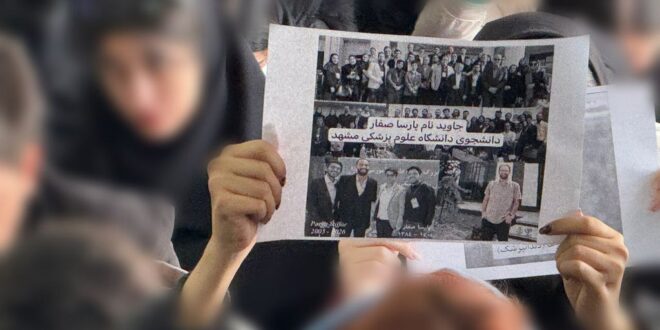
Solidarity with the people of Iran and protests against the Islamic Republic’s genocidal crimes continue to expand across society.
Teachers’ and doctors’ organisations condemn the regime’s crimes
On 3 February 2026, the Coordination Council of Teachers’ Trade Associations of Iran issued a statement condemning the mass killings, bloody repression, and organised crimes committed against protesting citizens. The statement describes the current period as one of the bloodiest in Iran’s contemporary history, marked by:
- the killing of women, men, children, and adolescents
- mass arrests and enforced disappearances
- inhuman pressure and abuse in detention centres
The council noted that teachers and students have been among the direct victims of this repression, with more than ten teachers and dozens of innocent students killed during protests. It stressed that the regime views education and awareness as a threat to its survival and declared that teachers stand firmly alongside the protesting people as an inseparable part of the struggle for freedom, social justice, democracy, and human rights.
The Coordination Council put forward the following demands:
- The ruling authorities are directly responsible for the killings and repression and must be held accountable before the Iranian public and independent international bodies.
- All detainees — including students, teachers, and labour, civil, and professional activists — must be released immediately and unconditionally.
- The militarisation of schools, universities, and educational spaces must end immediately; education is not a battlefield.
- People of conscience around the world must stand in solidarity with the people of Iran and refuse silence in the face of state brutality.
On the same day, the Fars Province General Practitioners’ Association issued a statement expressing solidarity with the people and deep concern over the deaths of doctors and healthcare workers who courageously treated injured protesters during the regime’s violent assaults. The association warned that reports of summonses, arrests, and pressure on doctors for fulfilling their professional duties, as well as violations of the security of medical spaces, pose a serious threat to the healthcare system, public trust, and safe access to treatment.
The association stressed that:
- Treating the injured is not a crime and must not be criminalised under any circumstances.
- Medical duty must not be carried out under fear, pressure, or non-professional consequences.
- Medical neutrality and human dignity are non-negotiable principles.
It demanded the immediate lifting of all pressure on doctors and healthcare workers, practical guarantees for their professional security, and full respect for the sanctity of medical facilities.
“Tuesdays Against Execution” campaign marks its 106th week
On Tuesday, 3 February 2026, the “Tuesdays Against Execution” campaign completed its 106th consecutive week of action, now active in 56 prisons across the country. In its weekly statement, the campaign reported that more than three weeks after the January massacres and the arrest of tens of thousands of citizens, many families remain completely unaware of the fate of their loved ones.
The campaign described the regime’s actions as state murder and enforced disappearance, holding the Supreme Leader directly responsible. It warned that many detainees face secret trials without fair legal process and are at risk of heavy sentences and execution, while independent lawyers are being threatened and barred from representing January uprising detainees.
Key figures cited include:
- 123 executions carried out so far in February
- More than 2,350 executions since the beginning of the year
The campaign called on families of detainees and victims to publicise names and information, and urged the public, activists, and human rights defenders to amplify the voices of prisoners. It welcomed the European Union’s designation of the IRGC as a terrorist organisation as an important step reflecting long-standing demands of the Iranian people.
Families of political prisoners Vahid Bani-Amarian and Pouya Ghobadi also joined the campaign this week, as in previous weeks, by holding photographs and placards in support.
Student protests and exam boycotts continue
Student protests continue nationwide. More than thirty universities have joined end-of-term exam boycotts in protest against the regime’s genocidal killings. At Shiraz University of Medical Sciences, protest gatherings and sit-ins continued for a second consecutive day on 3 February 2026. Students gathered outside educational buildings and examination halls, refusing to return to normal activities and chanting slogans such as:
- “Sworn by the blood of our comrades, we stand to the end”
- “The student dies but does not accept humiliation”
- “Imprisoned students must be freed”
Students strongly condemned the arrest of students and healthcare workers, the continued security pressure on universities, and the regime’s ongoing crimes.
These statements, campaigns, and protests together represent the unified and growing voice of Iran’s justice-seeking society — a voice that has now become global.
Worker-communist Party of Iran
3 February 2026
Be the first to comment