In this speech, Hamid Taqvaee argues that the January mass killing — in which more than 30,000 people were slaughtered in 48 hours — is not a sign of regime strength but of its impending downfall. He describes it as a political earthquake that has made any return to “normality” impossible.
Yet amid the bloodshed, green shoots are emerging: defiant memorials, renewed street protests, growing self-organisation in neighbourhoods, workers and retirees returning to the streets, and a society that refuses to be intimidated. The Woman, Life, Freedom revolution is not over — it is evolving.
The task now is clear: organise, expand strikes, strengthen grassroots networks, and internationally isolate and boycott the regime. The regime has signed its own death warrant. The question is not whether it will fall — but how we will bring it down.
Green shoots after the bloody January
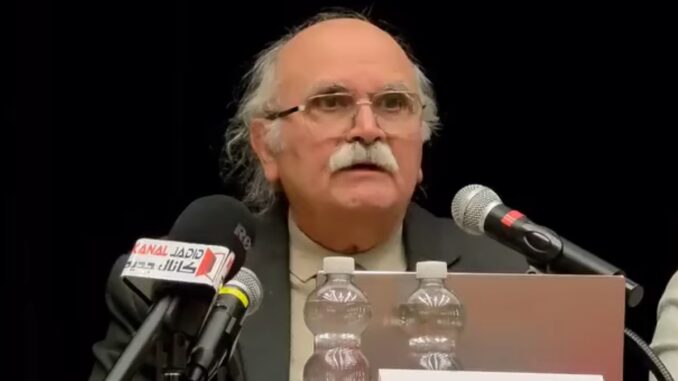
Speech by Hamid Taqvaee at the seminar “Protest movements after the nationwide uprising and the massacre of the people in Iran”
Frankfurt, 7 February 2026
Let me begin by saluting the free and heroic people of Iran, and by expressing my condolences and solidarity with all those who have lost loved ones to the Islamic Republic, especially in the past month, in January 2026.
Before asking what must be done—which I will focus on—we must first understand the current political situation in Iran.
I believe the massacre that took place in January is qualitatively different from any crime in modern history—not only under the Islamic Republic. The Islamic Republic holds the record for executions; it is the regime of the mass killings of the 1980s, the chain murders, the chemical attacks on girls’ schools, the shooting down of a passenger aircraft, the blinding of protesters in the streets, the crushing of the uprisings of 2017, 2019, 2009, and so on. But what happened in January is on another level.
If today you describe the Islamic Republic merely as a regime of executions, you are being too kind; you are not telling the full truth. If you call it a regime of gender apartheid, or the axis of the terrorist movement of political Islam, you still have not said everything. This is a regime of genocide. A regime that killed more than 30,000 people within 48 hours—according to the figures so far available, 30,000, though the real number is far higher. We still do not know the final toll.
In history, how many governments can you name that killed 33,000 of their own people in two days? I cannot recall any. Yes, there have been regimes that killed thousands or millions in wars—against so-called “enemies.” There have been dictatorships that over decades murdered thousands of their own citizens. There have been regimes like the Islamic Republic that crushed uprisings and then tried to calm society and restore “normality.” But what do you call a government that fires volleys from rooftops, with laser sights aimed at the hearts and heads of young people—not only protesters but passers-by? Is that merely “repression”? That is too mild. A regime of executions? A regime of massacre?
In history we have seen cases such as the genocide of the Armenians, the events in Yugoslavia, the atrocities in Rwanda. The Islamic Republic surpasses them all. And this is not only a human catastrophe; it is a political earthquake. No government can remain standing upon a sea of its own people’s blood. It cannot. The Islamic Republic knew this. Why did it commit this crime? Because it saw its overthrow on the horizon—in the short term. If the movement that began in early January had continued, the regime had no confidence it would survive the following month. It knew it could not sweep this crime under the carpet. It knew it could not hide it. It knew that—but it had no choice. It went all in. It said: if I am falling anyway, let me carry out a massacre; perhaps I will survive.
This is different from 2019 and 2017. Then, it managed the situation. It struck, stepped back, manoeuvred, calmed things down, and carried on. But now, like a madman cornered, it has smashed its head into the wall. It has shot itself in the foot. It has exposed itself and isolated itself internationally. It knows the people thirst for its blood. These people will not return to “normal.” The Islamic Republic will not return to Azar. This is a regime of genocide. An Islamic holocaust. Words fail me. And the people of Iran know it. The people of the world know it. The regime’s own factions know it.
Different factions that once tugged at Khamenei’s sleeve—don’t do this, negotiate, compromise, lift sanctions—now, like mafia gangs fearing for their survival and their continued plunder, rush to kiss the hand of the “Godfather.” They go to Khamenei, though they blame him for this situation. Like rival mafia members (if you have seen The Godfather), who compete over wealth and power but unite when they face a common threat. That is what is happening within the regime. Newspapers close to the regime are attacking one another. Former and current “reformists” who once sought to bypass Khamenei, commanders of the IRGC who spoke of moving beyond him, now all swallow the poison chalice in a mixture of fear and submission, acknowledging the bitter truth that their system is collapsing—hoping only to die later rather than sooner. That is the regime’s condition.
I do not see this massacre as a sign of strength; on the contrary, a regime that does this signs its own death warrant. Its survival is impossible. This is not the era of the Mongols or Genghis Khan. This is the twenty-first century. Not even a tenth of this crime has yet been fully exposed. When the world learns the full truth, humanity will not be able to swallow it. It cannot digest it. It is impossible to move past this crime.
This regime is not sustainable—and they know it. But nothing will happen automatically. What must be done?
In other societies without Iran’s conditions—Arab Spring countries, Syria under Assad, Iraq after Saddam—a dictatorship might be replaced by another dictatorship. But not in a society that in the past four years has raised a banner known worldwide as the Woman, Life, Freedom revolution—the first women-led revolution in history. A vast movement that resonates globally, that inspires feminists in Western Europe and justice-seekers everywhere. They want to turn this into “Long Live the Shah.” It will not take. You cannot turn gold into copper.
This is a society with an organised left, with hundreds of statements advancing the most progressive demands, with networks, activists, recognised faces, songs, singers, writers, parties, NGOs, trade unions and councils—from the National Council of Teachers to the Vahed Bus Workers’ Syndicate, to the Oil Protest Councils, to the Writers’ Association, to the associations of families seeking justice for the downed airliner, to the Mothers of Khavaran. This society is concrete, organised, left-wing, humane. You cannot turn gold into copper.
Now the monarchists and their thugs have entered the scene from the other side. And here we stand—those who speak the people’s heart, who represent the rising society, who keep the banner of Woman, Life, Freedom aloft and want to move it forward. The question “what must be done?” concerns us—not those standing outside the ring trying to impose themselves.
First point: Iranian society was not intimidated. Within a week of the massacre, protests sprouted again. Look at the funerals and memorials. They began with applause—and applause at a mourning ceremony is a finger in the eye of the Islamic Republic. With singing and dancing. With chants of “I will kill the one who killed my brother.” And recently: “Death to Khamenei, curse upon Khomeini.” The most radical slogans possible. A society that has lost more than 30,000 people returns to the streets and shouts these slogans. This society is not cowed.
We see a burned forest—but also green shoots emerging. One of those shoots is the memorial ceremonies. We no longer have merely a justice-seeking movement; we have 95 million justice-seekers. The entire society is justice-seeking—and it turns this into offensive energy, into forward movement, not into retreat and despair.
Second: people have turned to mutual aid, like after an earthquake or flood. Doctors treat the wounded in homes; people gather supplies for families who lost breadwinners. Neighbourhood self-help organisations are forming. This is another sign of society standing upright.
Third: retirees are back in the streets with sharper slogans. Statements from teachers, the Vahed Syndicate, unions and protest councils circulate. The wheel has begun turning again. In a society under massacre and undeclared martial law, people organise self-help bodies and think about strikes. Workers and retirees are returning to the streets.
These are the shoots we must nurture and organise.
Outside Iran, the diaspora has a critical role. Imagine such a massacre happening in Spain or Italy. People would say: the world must not recognise this government. It is not even a dictatorship; it is a murderer of its people. Our party has demanded a boycott of the Islamic Republic for twenty years. The time has come. This regime must be politically, culturally, artistically and athletically boycotted. Even Russia refused entry to Iran’s wrestling team the day after the massacre.
We must mobilise globally to close the regime’s embassies, expel its officials and impose a full boycott. That banner must be raised abroad.
As for the “transition period”—I am beginning to question the term. Transition to what? Who owns it? First, overthrow the regime—then speak of transition. The people will manage the transition. After the regime falls, hundreds more councils, organisations and parties will emerge. Iranian society is not atomised; it is organised. This is not the Aryamehr graveyard. Under the Islamic Republic, society has formed countless organisations of struggle. They are the owners of the future.
Unity must have a material basis. If we stand together in the Oil Protest Councils, we can unite here. If we are active in the Teachers’ Council, Writers’ Association, environmental movement, then unity has meaning. Otherwise, unity around what?
To conclude: outside the country we must demand a total boycott of the Islamic Republic—just as the world boycotted apartheid South Africa, it must boycott the gender apartheid—and now genocidal—Islamic Republic. Inside the country we must support the justice-seeking movement, build neighbourhood solidarity, and move towards general strikes.
The Woman, Life, Freedom revolution is not an event; it is a movement. It is alive. It will define Iranian society for decades to come. We must keep it alive against all attempts to hijack it towards reaction.
If we consider ourselves revolutionary, humane, liberatory and civilised forces, this is the only path.
Thank you very much.
12 February 2026
AI-assisted translation, from the original Farsi