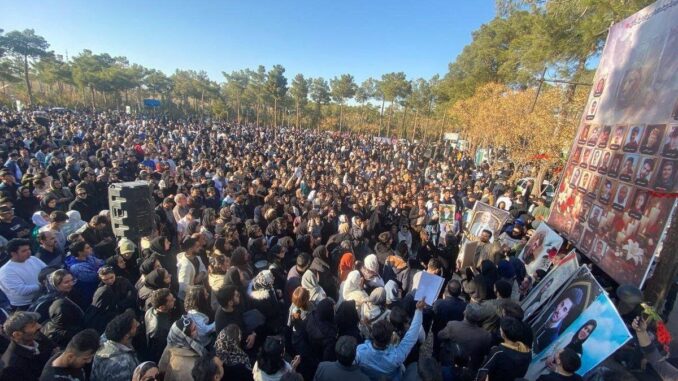
On 17 February, mass memorials across Iran marked the fortieth day since the January massacre, turning cities into powerful scenes of protest. From Abdanan and Mashhad to Tehran and Karaj, thousands gathered at cemeteries chanting “Death to the dictator” and demanding justice, despite gunfire, arrests and heavy security presence. Markets closed, universities continued exam boycotts, and the “No to Executions Tuesdays” campaign warned of mass death sentences against detainees. The scale of participation shows a society that refuses to retreat — and is preparing for a larger confrontation with the regime.
Mass commemorations across Iran on 17 February
Markets close, universities boycott exams, schools prepare to shut down
A powerful wave of protest swept across Iran on 17 February as large public gatherings marked the fortieth day since the January massacre. Calls to stop work and attend memorial ceremonies on 17 and 18 February were met with widespread response, turning cities into sites of mass commemoration and protest against the regime’s killings.
In Abdanan (Ilam province), where many were killed in January, thousands gathered at the cemetery for the fortieth-day memorial of Alireza Seydi. Chants of “Death to Khamenei” and “Curse on Khomeini” echoed through the crowd before security forces opened fire to disperse mourners and cut internet access. Military vehicles surrounded the cemetery entrance. Shops in Abdanan and nearby Dehloran closed in solidarity. The city had previously been one of the epicentres of January’s uprising.
In Najafabad (Isfahan province), thousands attended memorial ceremonies.
In Mashhad, large crowds gathered for the fortieth day of Hamid Mahdavi, chanting:
- “We did not give our lives to compromise or praise a killer leader.”
- “Death to Khamenei.”
- “By the blood of our comrades, we stand to the end.”
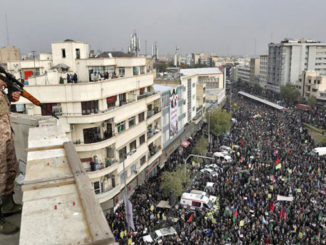
In Tehran (Behesht-e Zahra cemetery), massive crowds gathered, chanting:
- “This many years of crime — death to this rule.”
- “Death to the oppressor.”
Memorials were also held in Zanjan (Ilya Ajaqlou), Hashtgerd (Mehran Salimi), and Chalus (Yousef Bakhshi). In Karaj, large crowds commemorated Reza Habibi and Sajjad Darab, chanting “Death to the dictator.”
Despite heavy security deployments in several cities, including Sanandaj, and reports of further arrests — including raids on homes in Chenar village (Asadabad) — the large public presence signalled defiance.
Meanwhile, universities remain in turmoil. Students in more than 30 faculties and medical universities across multiple provinces have boycotted exams, and protest gatherings continue. Several students were reportedly detained in Tabriz.
The “No to Executions Tuesdays” campaign continued in its 108th week across 56 prisons. Activists warned that tens of thousands detained during the January protests face torture and possible execution. Since early February alone, more than 300 prisoners — including three women — have reportedly been executed. Families of death-row prisoners joined the campaign publicly, holding photos and banners reading “No to Execution.”
As memorials expand, markets close, and educational institutions halt activity, Iran is witnessing an atmosphere of collective anger and mobilisation. Across the country, people declare that no level of crime will force them back.
Worker-communist Party of Iran
17 February 2026