
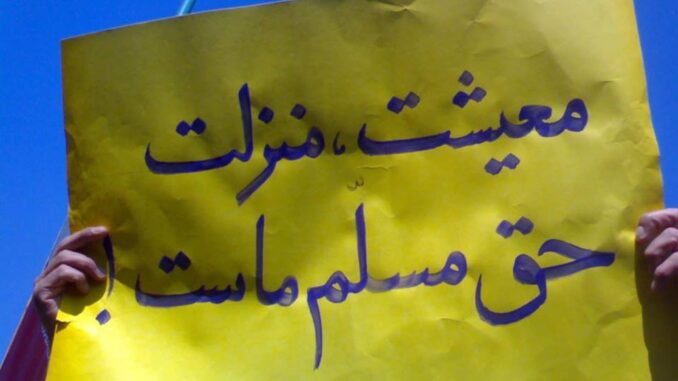
Adopted by the Political Bureau of the Worker-communist Party of Iran
18 November 2024
1. The economy under the rule of the Islamic Republic is an economy that is deeply crisis-ridden and paralysed. The West-hostile identity of the Islamic Republic and the regime’s key role in the movement of political Islam have produced an economic system that is sanctioned and isolated from the global market—one based on rent-seeking and dual exchange rates, smuggling markets, sanction profiteering, the domination of intermediary and contractor mafia gangs over imports and exports and various branches of production, and the like. Corruption and kleptocracy are institutionalised components of this system. It is an unstable system, not predictable or planable even in the medium term, lurching from one expedient to another; as a result, it is confronted with a structural and institutional crisis whose cost is paid by workers and the masses of people driven below the poverty line.
2. These conditions have created a severe livelihood crisis whose defining features are crushing and devastating poverty and life below the poverty line for vast sections of the population; escalating inflation and the daily erosion of the purchasing power of the majority; widespread unemployment; and calamities such as deprivation of education and child labour. Slave-like and unbearable labour conditions for workers, teachers, nurses and public-sector employees, and intolerable livelihood pressures on different sections of the population—including pensioners, the millions of unemployed, border porters (kolbars) and fuel porters, people with disabilities, farmers and residents of deprived regions—are among the direct consequences of this situation.
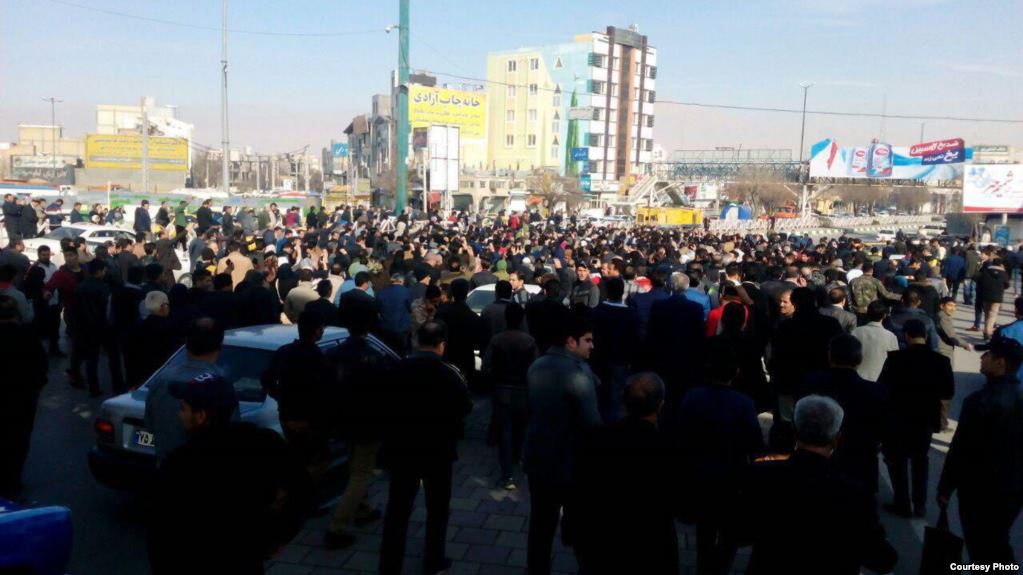
3. In response to these conditions, for years a broad movement over livelihoods, rights and welfare has been underway, encompassing vast sections of society, with pensioners and workers forming its main pillars.
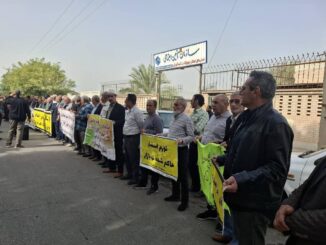
4. The movement over livelihoods and welfare is very broad and is taking on increasingly organised dimensions day by day. The daily protests of pensioners; large-scale protests in the oil sector and the entry of families into these protests; nurses’ protests; gatherings of people with disabilities; student protests over tuition fee increases; teachers’ protests; and farmers’ protests are prominent examples. Protests on this scale play a very important role in strengthening the political and protest atmosphere across society as a whole.
5. The immediate and direct objectives of the livelihood movement are wage and pension increases; confronting theft and embezzlement; securing unpaid wages; free treatment; health insurance and social insurance, and the like. Since the struggle to realise each of these demands and other workers’ demands is met with the regime’s repressive force, the livelihood movement is, by its nature, a political and anti-government movement. It is interwoven with protest against the ruling apparatus of plunder; against the domination of contractors and the regime’s mafia gangs over workplaces; against the regime’s warmongering; against executions, arrests and the securitisation of struggles; and with struggle against compulsory hijab and gender apartheid, turning away from religion, the fight for the freedom of political prisoners, and other arenas of struggle.
6. The livelihood crisis has been further intensified by the regime’s warmongering policies, making confrontation with it ever more urgent. In the context of wartime tensions between the Islamic Republic and Israel, the livelihood movement is an important instrument of this confrontation and a central pillar of an effective line-up of struggle against the regime’s warmongering.
7. In terms of the substance of its demands and the objectives it sets before itself, the livelihood and welfare movement is an anti-capitalist movement that confronts the entire ruling economic and political system. In particular, different sections of the working class play an active role in this movement. Both in its economic demands and in its political and social orientation, it is a radical, combative and clearly defined movement that represents the masses driven into poverty. The “Charter of Minimum Demands of Independent Trade Union and Civil Organisations of Iran” is the formulated expression of this movement.
8. The livelihood movement has both contributed to the formation of the Woman, Life, Freedom revolution and been directly influenced by it. After the eruption of this revolution, the atmosphere of protests and gatherings by pensioners, workers and nurses has become more radical and political, taking on a more offensive and forward-moving rhythm. “Unity, unity against poverty and corruption” is today a unifying slogan of this movement.
The Worker-communist Party regards the strengthening and expansion of the movement over livelihoods and welfare as an important and urgent task and strives to reinforce and develop this movement in various ways:
a) Practical unity among different sections of workers—teachers, pensioners, nurses and other sections protesting over livelihoods—is an important step in the advance of this movement. This fundamentally depends on alignment, coordination and practical cooperation among activists and bodies involved in protest movements around the livelihood demands of different sections of society, and active efforts must be made to achieve this.
b) Confronting embezzlement and astronomical salaries; ending repression and the regime’s assaults on livelihoods; and advancing nationwide demands such as wage increases; payment of wage arrears; adequate unemployment insurance for all unemployed people; free treatment and education; provision of suitable housing for all; removal of contractors from workplaces; and a basic income for all citizens are concrete demands and key arenas of struggle for the livelihood movement today.
Pensioners, workers, teachers and nurses constitute the organised core of livelihood protests and, by strengthening this dimension of struggle and raising the banner of these demands, can play a decisive role in uniting and mobilising tens of millions of impoverished people driven into extreme poverty and misery, and in launching a massive movement against the present harsh conditions.
c) Confronting the regime’s repression—by demanding an end to the securitisation of struggles; the closure of all security cases; the freedom of all political prisoners; the immediate abolition of the death penalty; the halt to executions; and the annulment of issued death sentences—can and must increasingly spread within the livelihood movement.
d) The movement over livelihoods and welfare has both the capacity to move towards nationwide strikes and, through its broad on-the-ground mobilisation, can directly influence the expansion and strengthening of street protests and gatherings. Moving towards broad and general strikes can and must consciously be placed on the horizon of the current movement. Nationwide strikes by teachers, oil workers and other sections of the working class, nurses, and nationwide coordination of pensioners with these sectors must be placed on the agenda of leaders of protest movements and of the livelihood movement as a whole.
e) The radical and political content and orientation of the livelihood movement have great significance in the country’s current political situation. It is an important stronghold for setting radical and humane discourses and policies in motion, and a crucial lever for neutralising manoeuvres conducted over the heads of the people. Strengthening and deepening this orientation must be actively pursued.
f) The expansion of protests, gatherings and strikes by different sections of the population over livelihoods, within the society’s political and revolutionary atmosphere, is extremely important and vital. It is an effective response to the regime’s repression, executions and warmongering, and possesses the capacity to mobilise society on these fronts and at this scale. The Party calls on all sections of the working class and all protesting people in society to align with this movement and to strengthen and expand struggles over livelihoods around nationwide demands and against the regime’s assaults.
18 November 2024
AI-assisted translation, from the original Farsi
Be the first to comment