
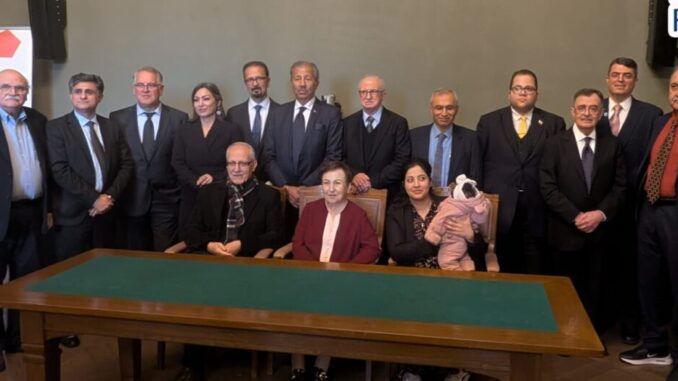
Why the Oslo conference matters — and why the attacks on it don’t
In this sharp and polemical interview, Hamid Taqvaee explains why participating in the Oslo conference on “Human rights in Iran after the Islamic Republic” was not a retreat, but an active intervention in today’s political struggle. He responds directly to attacks from both the monarchist right and the sectarian left, exposes the myths of “separatism” and purist isolation, and argues for a politics of active engagement, unity in struggle, and uncompromising criticism. A clear defence of why communists must be present everywhere the fight against the Islamic Republic is taking place — from the streets to international forums.
The Oslo conference and hollow criticisms
Hamid Taqvaee — 25 October 2025
International: You recently participated, at the invitation of the Iran Human Rights organisation, in a conference in Oslo titled “Human rights in Iran after the Islamic Republic.” A number of other leaders of opposition parties and organisations also took part in this conference. What was your objective in attending, and to what extent did you achieve it?
Hamid Taqvaee: Our objective was to further introduce the aims and policies of the Party and to clarify avenues for alignment and cooperation with political forces that agree with parts of these policies.
At a general level, our approach is to use every platform, gathering and conference to present the Party’s views and policies and to work towards bringing opposition forces together in pursuit of the realisation of any part of these policies. Especially in the present circumstances, when the broad Woman, Life, Freedom movement is underway, we are prepared to engage in discussion and dialogue with any party or opposition force that seeks the overthrow of the Islamic Republic, and to try to find ways of cooperation aimed at strengthening and further advancing the Woman, Life, Freedom movement and its various arenas—such as the movement against poverty and corruption, the movement against executions, the justice-seeking movement, the struggle for the freedom of political prisoners, and so on. We consider any force, to whatever extent it works and struggles for the realisation of any clause of our Party’s programme, to be our comrade-in-arms—while at the same time we neither conceal nor soften our criticisms and strategic and political differences with other parties; on the contrary, we have always expressed them openly and clearly. As one example, we have a deep critique of federalism and have articulated this critique in various forms, yet at this very meeting we issued a joint statement with several federalist parties against death sentences and the very institution of the death penalty. Our principle is this: persistent critique of programmes, objectives and policies that are incompatible with welfare, freedom and equality—and, in general, with the liberation of society—combined with practical cooperation with all forces active in every arena of struggle against discrimination, poverty and repression, and against the Islamic Republic.
Our participation in the Oslo conference pursued precisely these aims. The conference was a suitable opportunity to present the Party’s views and policies, particularly in relation to the transition period. In the panel in which I spoke, as far as time allowed, I explained the foundations of the Party’s policies not only regarding the transition period—which was the conference’s stated theme—but also on freedom of expression and the Party’s critique of federalism. I also raised points in response to the remarks of other panellists. These contributions have been published, and interested comrades can refer to them.
As to how far our objectives in attending the conference were realised, I would say that overall the conference was successful. First, all participating forces expressed their views in a friendly and civilised atmosphere, and people who followed the conference—or who will later return to its discussions—will become more familiar with the participating parties and figures, and with the differences in policies and priorities among the parties. Second, the conference issued a joint statement in support of Tuesdays against executions and against the death penalty—a particularly positive and timely step in today’s conditions, when executions are rampant in Iran. On the second day of the conference, a draft document on minimum principles of human rights during the transition period was also discussed, and proposals were made to amend and complete certain clauses. It was agreed that the organisers would prepare the final text and circulate it to conference participants. I hope that in this case too we will be able to issue a joint statement.
International: After the Oslo conference, forces from both the left and the right of the opposition raised criticisms of the conference itself—from objections by some left forces to the venue of the conference, to accusations by the right that it was organised purely against Reza Pahlavi and the monarchy. What is your view of these criticisms—or, rather, these oppositions?
Hamid Taqvaee: Right-wing forces have essentially opposed the conference from two angles. The first is that they believe the conference sidelined Reza Pahlavi and was organised precisely for that purpose! Apparently, in their worldview, politics revolves around the “Prince”! This kind of self-aggrandisement is perhaps comparable only to Trump’s own self-aggrandisement. After all, their model is King Trump; it would have been surprising if they behaved otherwise.
The second aspect of monarchist opposition is hostility towards any party or force that traces its identity to a nationality other than Persian. Their pretext is the preservation of territorial integrity. While no separatist force was present at the conference, the monarchists label it a gathering of “separatists” and, as always, brandish the club of the spectre of separatism and threats to territorial integrity. Separatism is a fabricated accusation used by monarchist forces to attack any party or force that opposes national oppression and discrimination. From the standpoint of Persian great-power nationalism, the people and political forces in Kurdistan, Azerbaijan, Baluchestan and other border regions are either “valiant border guards” or “vanquished separatists”!
What lies beyond the imagination of Persian nationalism is the fact that national oppression and discrimination are bitter realities of our society—bitter realities that must be confronted by fighting to uphold the human dignity and identity of all the people of Iran as citizens with equal rights in all spheres, independent of any ethnicity, nationality, religion, race or any other ethnic characteristic. Throughout Iran’s modern history, Persian nationalist states and forces have themselves been the source and agent of the imposition of various forms of oppression and disenfranchisement on the people of border regions. It is therefore entirely natural that they should become enraged and foam at the mouth over the holding of a conference that addresses this old and chronic oppression. In my view, the very attacks by right-wing forces on the Oslo conference are evidence of the conference’s legitimacy.
The other group criticising the Oslo conference consists of left forces who claim communism and whose defining feature is purism and withdrawal. In their criticisms, the content and substance of the speeches at the meeting, or the conference’s joint statement against executions, scarcely feature at all. What they object to is the very holding of a conference in Oslo—on the “crushing” grounds that imperialist treaties have been concluded there; the claim that the conference was a regime-change initiative; the presence of non-communist parties at the conference; the fact that two of the participants had also attended a Georgetown meeting about three years earlier; the assertion that human rights is a bourgeois concept; and similar matters. We call these forces the pavement left, because even at the height of the Woman, Life, Freedom revolution they refused to take part in demonstrations of tens of thousands, on the grounds that the Lion and Sun flag could be seen there. They gathered on the pavement, chanting their own slogans among a small circle of their own, and felt radical. The latest example of this paper radicalism was their attack on the demonstration against the reopening of the Islamic Republic’s mosque in Hamburg. Not only did they, as usual, fail to take part in this protest, but, using the pretext that the Israeli flag had been raised there, they made it their mission to attack and denounce the entire anti-mosque demonstration—against a mosque that is a base of the Islamic Republic in Germany. Apparently, it is sufficient for the flag of any reactionary state to be raised at a just protest for the entire protest to be rendered illegitimate! From the standpoint of our comfort-seeking friends, street protests against the Islamic Republic are permissible only with communist flags and the exclusive participation of communists—and nothing else.
This same sectarian criterion has now been extended to conferences as well. In their view, one should associate only with the left, and any action beyond this is deemed compromise, rightward deviation, and so on. Unfortunately, debating with oneself and endlessly circling around one’s own positions has become institutionalised in this sectarian left. For this type of left, the task is merely to take positions—solely to interpret the world, not to change it. A mode of positioning that condemns every force and movement other than itself and its like-minded circle, constantly issues prescriptions about what should not be done, and justifies its own isolationism and inaction. The crux of the matter is that the struggle to change the world requires active presence and intervention in all arenas—from street struggles to conferences and gatherings, and so forth—something that the purist, sectarian left is unwilling to engage in.
My final word to these comrades is this: in the class struggle, no one rolls out a red carpet for you. The political forces of the propertied classes do not sit at home waiting for you to grace the field with your presence! The bourgeoisie must be defeated on its own terrain. Communists are obliged not only to fight persistently in every arena against every form of discrimination and disenfranchisement, but also to unite with and draw together all forces that are active against any aspect of the inverted miseries of our world. Playing this active and interventionist role by communists—especially in today’s Iran, where the immense Woman, Life, Freedom movement is underway—is absolutely decisive and vital for bringing down the Islamic Republic and for realising a free, equal, prosperous and humane society; for securing a life worthy of the dignity of twenty-first-century humanity for all the people of Iran.
25 October 2025
AI-assisted translation, from the original Farsi
Be the first to comment