Once again, the charge of “separatism” is being used to threaten political forces that demand an end to national discrimination in Iran. But who benefits from turning this into a taboo? And what kind of “order” is being prepared in the name of territorial integrity?
In this article, Hamid Taqvaei takes apart the narrative being pushed from above and argues that the real issue is not separatism, but the attempt to preserve domination and suppress revolutionary forces after the fall of the Islamic Republic.
The bogey of ‘separatism’ and Reza Pahlavi’s threat against the people of Kurdistan
By Hamid Taqvaee – 25 February 2026
Recently, Reza Pahlavi, under the pretext of an alliance among several Kurdish parties and organisations, has once again begun issuing threats against so-called “separatists.” In his view, any political force or organisation that calls for the abolition of national discrimination is “separatist” and must be suppressed by the force of a “national-patriotic army.” He has not reached any position of power, yet he is already brandishing his non-existent army against alleged “separatist” forces. Apparently, invoking separatism is meant to justify any crime. This taboo must be broken. There is no separatist party or organisation in Iran — but even if such a party did exist, it would not be committing a crime. In Western democracies, separatist parties operate openly and in some cases even hold seats in parliaments and governments. Separatism is only a taboo for chauvinist dictators obsessed with grandeur; this taboo must be shattered over their heads.
Attacking non-Persian forces under the banner of “territorial integrity” has been a hallmark of Persian chauvinism and of all the dictators who have ruled Iran over the past century. Mr Reza Pahlavi appears intent on following the same path. Resorting to force against people and political forces who, after the overthrow of the Islamic Republic, demand the abolition of national discrimination is part of the monarchists’ horizon for dominating a revolutionary society after the fall of the regime. Preserving “order and security” after the collapse of the Islamic Republic; imposing martial law in “unrest-prone” cities; using the IRGC and Basij and integrating them into the army “to maintain security”; and alongside this, suppressing forces demanding an end to national discrimination under the pretext of separatism and violation of territorial integrity — all of these are components of establishing a new form of dominating power in the post–Islamic Republic period. This is not a scenario for “managing the transition,” but an attempt to salvage as much as possible of the existing dictatorship and its repressive apparatus in the face of the revolutionary advance that overthrew the Islamic Republic. What matters to the monarchists is action against the revolutionary popular forces who brought the regime down — an attempt to sideline the people, suppress them and send them back home.
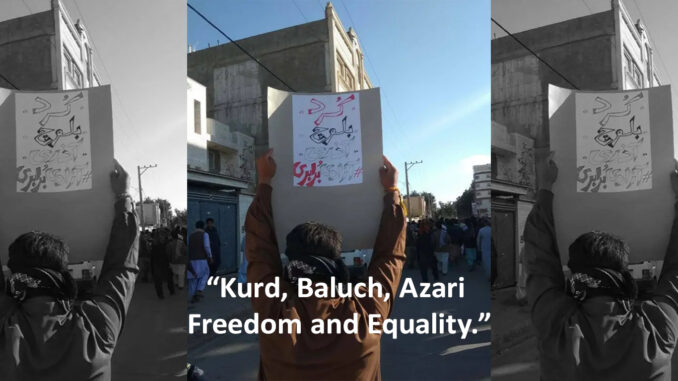
Reza Pahlavi appears to dream of a scenario similar to Khomeini’s confrontation with the aftershocks of the February uprising up to 20 June 1981. But if Khomeini’s scenario was a tragedy, Pahlavi’s would be nothing more than a pitiful farce. Iranian society today — not least thanks to the Jin, Jiyan, Azadi (Woman, Life, Freedom) movement — is far more conscious, organised and united than to allow the revolution to be crushed once again in the name of revolution. Threats and intimidation directed at left-wing and republican opposition parties and forces in Kurdistan, in border regions and across Iran — in a society that has risen with the slogan “Kurd, Baluch, Azari — freedom and equality” — will yield nothing but the disgrace and isolation of those who issue them.
Hamid Taqvaee
25 February 2026