
Statement by the Worker-communist Party of Iran
On the ceasefire in the war between the United States, Israel, and the Islamic Republic
The war by the United States and Israel against the Islamic Republic—having reached a highly dangerous point with the regime’s closure of the Strait of Hormuz and Trump’s threats to devastate Iran—has been halted by a two-week ceasefire, following the Islamic Republic’s agreement to reopen the Strait and the opening of negotiations. Both sides now claim victory: Trump for imposing a ceasefire and forcing the reopening of the Strait of Hormuz, and the Islamic Republic simply for having survived.
The ceasefire occurred under conditions in which the Islamic Republic managed to reduce the central issue of the war to the opening and closing of the Strait of Hormuz. At the same time, Trump accepted that the Islamic Republic’s proposal would form the basis of negotiations. Undoubtedly, the regime will use these factors—above all, its mere survival after 39 days of war with the world’s most powerful military—to engage in propaganda and intimidation directed at the people. But the reality is that the Islamic Republic is the political and military loser of this war. It has lost its leader, key officials and commanders; its repressive apparatus and military centres have suffered heavy blows; internal factional conflicts have intensified; and its regional and international crises have deepened. In such conditions, the people’s war against the Islamic Republic—already sharpened by the bloody January massacre—has entered a new phase.
One crucial point must be emphasised: as long as the Islamic Republic remains in power, war and war-like conditions will not end. Experience has shown this, and especially after the twelve-day war, the militarised atmosphere has intensified and expanded in ways that cannot be reversed. This war has pushed the region into a new phase of instability and potential conflict. The Islamic Republic now finds itself not only in confrontation with the United States and Israel, but effectively in a state of tension with regional governments that were not previously at war with it. These states now recognise that as long as this regime exists, security and stability will remain out of reach. Even economic and tourism environments in countries such as the UAE, Qatar, and Kuwait—once seen as relatively stable—have become fragile and uncertain. This situation is likely to push these governments to increase pressure, whether through war or other means, and to strengthen their defensive capacities against the Islamic Republic. The growing tensions between the regime and regional states are themselves a key driver of future military crises in the region.
Another important point is that even if this war comes to a halt, it is highly likely that the Islamic Republic—having lost key leaders and decision-makers—will soon face sharp internal divisions and power struggles. This, in turn, will create more favourable conditions for the advance of the movement to overthrow the regime and for further blows to be delivered by the people.
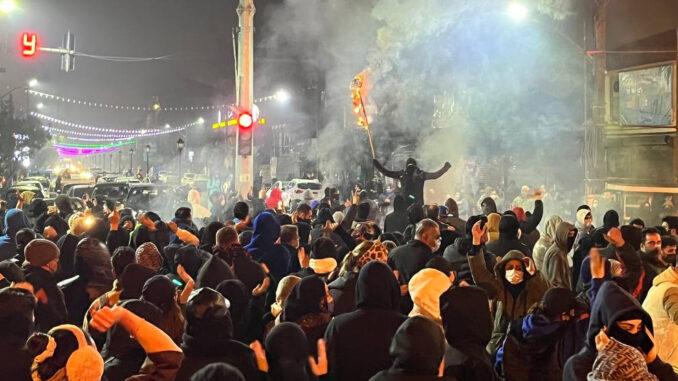
For the people of Iran, there is no ambiguity: they hold the Islamic Republic fully responsible for this war and its consequences. They reject both the regime’s proxy forces and its missile and nuclear policies. If this pause in the war continues, it will create space for the renewal of protests, demonstrations, and various campaigns—in essence, the continuation of the people’s war against a regime that has been severely weakened by its conflict with the United States and Israel.
In confronting its main enemy—the people—the regime shut down the internet under the pretext of war, effectively placing society under an information blackout. It intensified executions, continued arrests and sentencing without pause, and escalated its most criminal threats against protesters. During just three weeks of war, the regime executed 14 protesters on various charges, while thousands were arrested and many more now face heavy sentences, including the threat of execution.
These realities show that the people’s war against the Islamic Republic has continued throughout the interstate conflict—and that after the ceasefire, it is set to expand even further. As workers’ organisations declared after the end of the twelve-day war [with Israel in June 2025], the people’s struggle against the Islamic Republic has no ceasefire.
The regime knows that those who will overthrow it are not Trump or Netanyahu, but the people themselves. A people who have maintained their unity, who were not intimidated even by the horrific January massacre and the mass arrests of tens of thousands, and who quickly returned to protest through hundreds of gatherings and demonstrations across dozens of universities. A people who recognise this regime as the source of war, poverty, and repression. A people who have no ceasefire with their enemy—and who will continue their struggle until victory. We must prepare to organise and expand this struggle under these conditions.
Worker-communist Party of Iran
8 April 2026
AI-assisted translation, from the original Farsi


