
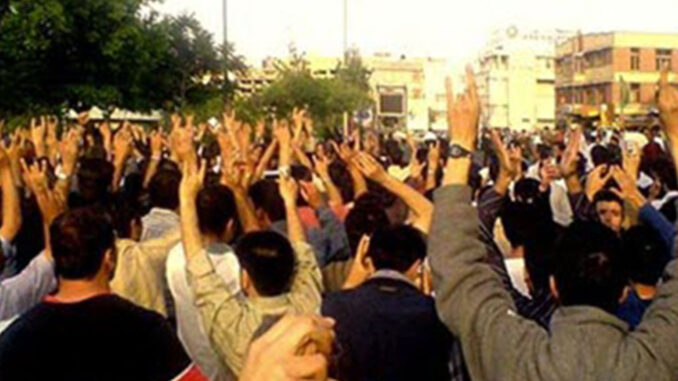
What does the “agency of the people” really mean beyond slogans? In this interview, Hamid Taqvaee argues that people can only play a decisive role when they are organised — in the struggle to overthrow the Islamic Republic, in the transitional period, and in shaping the future political system. He contrasts parliamentary democracy and referendums with council-based organisation, presenting councils as the real framework for direct popular power, freedom and equality.
8 May 2026
Hassan Salehi: For some time now, the term “agency of the people” has become common in the political discourse of the opposition. In this programme, we want to discuss the agency of the people in different periods: in the process of overthrow, in the transitional period, and in the future system. But before that, my question is: in general terms, what is your view of the agency of the people?
Hamid Taqvaee: The first point is that the emphasis by opposition political forces on the agency of the people is a positive thing. In effect, they are saying that the people must count, must be involved in developments, and must be relied upon. This is a correct orientation. It is a kind of turning towards society instead of turning towards those above, towards governments, and generally towards forces standing above the people.
At the same time, however, merely speaking about the agency of the people is a kind of generalisation. Many forces, even reactionary states and parties, also speak of the people, the will of the people, representing the people, and so on. Many say: we represent the people, we want the people to be free, we want the people to achieve their demands, and so on — without making clear exactly how and by what means. This is a good starting point, but it is by no means enough.
The important question is in what form, in what framework, and in what position the people can truly have agency — that is, play a decisive role in realising their humane demands and goals, in making their interests, protests and slogans a reality, and in achieving freedom, equality and welfare.
The first point is that the agency of the people depends on the organisation of the people. Isolated and atomised individuals cannot intervene actively and decisively in any matter. Unorganised people cannot discuss, consult and reach common views on different issues, nor can they make conscious decisions on the basis of the necessary information. As a result, they can easily make decisions, or vote for this or that force, under the influence of emotions, daily events, prejudices or lack of awareness. This is the mechanism of people’s participation in Western democracies.
But even this level of participation is neither continuous nor permanent. Liberal democracy, although far better and more progressive than dictatorships such as the Islamic Republic, does not guarantee the real freedom of the people. For example, in Western countries elections take place every few years, and then for a period of four or five years people have no real means of intervention until the next election. During that time, a president, prime minister or any elected official can do as they please and ignore the demands and protests of the people. Therefore, this kind of reference to the people cannot even fulfil the demands of those who voted for the officials in question. In many cases, voters regret their choice after a short time, but by then it is too late.
Another issue is that unorganised and isolated people can be pushed in one direction or another under the influence of emotions, prejudices, news and daily excitement. Populists and fascists operate in exactly this way. Through racial, ethnic and religious prejudices, they can draw sections of the people behind them. Khomeini acted in this way against the Shah’s regime and then at the beginning of his own rule. Therefore, the manner and method of referring to the people is extremely decisive.
People can make correct decisions — decisions based on their real interests — only when they are organised, when they discuss and consult with one another on different issues, and when they are informed and aware. And this means organisation. It is organisation that makes these things possible. This is where we emphasise councils and council-type organisations.
The real agency of the people can only have meaning in council-type organisations, because it is in councils that people, informed and aware, having discussed and exchanged views on different matters, can give their opinion and vote in a considered and thoughtful way.
Hassan Salehi: Given the definition you have given of the agency of the people, what does this mean in the process of overthrowing the Islamic Republic? We usually speak of people’s revolution, or of broad demonstrations and strikes. Is this what is meant by the agency of the people in the process of overthrow?
Hamid Taqvaee: In the process of overthrow too, the organisation of the people plays a fundamental role. In order for people to play an effective role and achieve the best results with the least losses, they must become organised on the broadest possible scale. Struggle — whether in the form of gatherings and demonstrations, local and nationwide strikes, or uprisings and attacks on the regime’s forces and centres — is not possible without organisation.
We revolutionary forces have always emphasised that in order to overthrow the regime, organised people must enter the field, organise themselves, and even take up arms and bring down the regime through uprising and attacks on state and security centres, repressive forces and institutions, and so on.
Here, the agency of the people means nothing other than revolution. Agency in the matter of overthrow means the exercise of the will of the organised people to bring down the government.
This is the basis of the discussion. But more specifically, from this principle — “the exercise of the will of the organised people in the matter of overthrow” — we arrive at various forms of mass organisation. These are organisations that have been created at different levels and in different forms during the Woman, Life, Freedom revolution and movement, and up to the present day.
Today, many of these organisations, thanks to the internet, have a networked form. Many have taken the form of nationwide councils: councils as protest organisations, such as the Coordinating Council of Teachers’ Trade Associations, the pensioners’ councils, the nurses’ councils, the protest councils of oil and petrochemical workers, and so on. All these exist. In fact, in the fighting culture of workers — and not only workers, but also students, justice-seeking families, pensioners and others — the council has become a tradition and an effective organisation for struggle.
From the standpoint of our party, the council, as an instrument of struggle, is the most appropriate and effective form of organisation. In today’s Iranian society, in addition to councils, various institutions, committees, associations, NGOs and other bodies have also been formed. They are active in different fields, essentially against the regime as a whole, and with an orientation towards overthrow. Organising in councils and in all these forms of organisation is the concrete meaning of the agency of the people in the process of overthrowing the Islamic Republic.
Hassan Salehi: Here we come to the agency of the people in the transitional period — that is, the period after the Islamic Republic has been overthrown but before the future system has been established. Some opposition forces speak of the ballot box and referendum as the agency of the people in the transitional period. What is your understanding of the agency of the people during the transition?
Hamid Taqvaee: By its very definition and nature, the transitional period means a prominent role for the people in politics. Contrary to the view that the people who have overthrown the regime through their revolution will simply return to ordinary life, after which there will be a referendum, a constituent assembly and so on, developments do not unfold in that way.
The experience of the 1979 revolution, and of revolutions generally, shows that in the period when the previous government has been overthrown and a normal state has not yet taken shape, the people acquire a prominent role. The reason is clear. A society that has risen up, struggled, demonstrated, struck, rebelled and brought down a government has only just become aware of its own power. It has only just realised that it can assert its own view and shape the course of events as it wishes. This political psychology in the transitional period arises from the self-confidence of the masses to intervene directly in politics and political decision-making.
Another point is that the transitional period is, by definition, a period in which authorities are broken. People who have triumphed in a revolution no longer accept authorities standing above them. They recognise themselves and their own organisations and figures of struggle. It should be noted that by the intervention of the people, I do not mean that parties disappear. Rather, parties play an important role through grassroots and field-based organisations of struggle.
In particular, political forces and parties that have fought against the regime during the revolution become popular in society and are looked to by the people. Many activists and masses of people have certain party inclinations, and naturally the party that will have the greatest influence is the one that represents, in the clearest, most radical and most comprehensive way, the revolutionary demands and aspirations of the people — both during the revolution and in the transitional period — especially the direct intervention and role of the people in politics, and that strives for this.
During the revolution, people have seen the performance of parties, judged them, and seen the active role of this or that party in the overthrow. In the transitional period, when the prison of repression has been broken open, they join this or that party, or become its supporters and advocates. In any case, it is the people who, both through mass and field-based organisations and through parties, will play a prominent and entirely decisive role in the transitional period.
It is often said that the transitional period is a period of power vacuum. In my view, however, the transitional period is the period of the power of the people. Factories fall into the hands of workers because the transitional period is a period in which the system has fallen apart, and capitalists and factory owners have fled. Especially in the Islamic Republic, where the vast majority of factories and production centres are directly or indirectly in the hands of regime officials, this abandonment will affect most industries. They will all be left without owners and managers. Who will fill this space? The workers who have made the revolution. Workers who have organised in councils or other mass organisations during the revolution or in the transitional period.
The same applies to universities and state offices. One government has gone and another has not yet arrived; therefore society itself, having gained self-confidence in the revolution, takes matters into its own hands and engages in direct action. The various organisations of struggle formed during the revolution — including the councils I mentioned — will not dissolve themselves after the overthrow. On the contrary, they will become stronger, broader and more mass-based, and will intervene actively in politics.
They will test any force that calls itself a provisional government, or seeks to write a constitution, hold a referendum, and so on. They will place on their agenda the realisation of the demands, slogans, charters and goals they pursued during the revolution. Revolution raises the expectations and aspirations of society. The Woman, Life, Freedom movement has already raised a high ceiling of demands and aspirations: complete equality between women and men, separation of religion from the state, abolition of the death penalty, ending the class gap between poverty and wealth, the rights of LGBTQ+ people, justice-seeking and the trial of the leaders of the overthrown regime, and much else. These are the people’s criteria.
People will judge any force that wants to form a provisional government by these criteria. More importantly, the people’s organisations of struggle themselves will want to be present in the provisional government in order to implement the demands for which they made the revolution. In this way, the people’s organisations, which during the revolution were protest organisations, become organisations that determine the future system. Here too, council-type organisations, which make decisions and enter the field through conscious discussion and exchange of views, play a fundamental role. The transitional period is the best period for society to flourish in the direction of intervening in its own affairs.
Hassan Salehi: My final question concerns the period after the transition has ended and a new system has been established. Here too there are different models for the agency of the people. Opposition parties and forces mostly favour some form of parliamentary system and believe the agency of the people can be realised through parliamentary elections. What is your view of the agency of the people in the future system?
Hamid Taqvaee: When we speak about the future system, the role of parties becomes prominent. What perspective have parties placed before society? Today, the general division within the Iranian opposition is between republicanism and monarchism — or, as monarchists call themselves, constitutional monarchism. The monarchists want to return to 50 years ago, to a system that completely negated the agency of the people. Therefore, they have no place in this discussion.
Republicans, however, are divided into two groups: supporters of a federal republic and supporters of a central parliamentary republic. Another section consists of left parties such as our party. We too, in the general classification, support a republic, but we defend a council republic. We are neither federalists nor centralists. We call for the presence of the masses of the people in politics, in decision-making and in the administration of affairs through councils.
I explained earlier the role of councils as instruments of struggle to overthrow the Islamic Republic, and as institutions determining the fate of society in the transitional period. In a council republic, councils become the instruments of governance — that is, decision-making and implementation of decisions, appointment and dismissal of officials, legislation, and other matters relating to government and the administration of society. Councils are bodies that legislate, elect officials and dismiss them whenever they deem necessary, and carry out all affairs of governance at local and national levels.
In terms of organisational structure, councils will be connected to one another in the form of a nationwide network, and this is entirely possible with today’s technology and the internet. People can discuss, exchange views and make decisions even on nationwide issues.
We are opposed to federalism in the sense of ethnic local governments. Not only does it fail to resolve national and ethnic discrimination; by relying on national, ethnic and communal identities, it intensifies them. But if the aim is the participation of people in decision-making at local and provincial levels, then in our view councils are the best form of people’s intervention in politics, both nationally and locally.
If we believe in council government and take it as our model, then naturally government will no longer be centralised. Councils at local, city and provincial levels will be autonomous in administering their own affairs, and will have the right and ability to make decisions, legislate and implement laws. This is also the best form for overcoming national and ethnic oppression and discrimination.
As I explained at the beginning, the agency of the people will not be secured in a parliamentary system based on voting every few years. We can see this reality today even in Western democracies. For example, the overwhelming majority of people in the United States oppose Trump, but they are forced to tolerate him for another two years. Of course, this parliamentary democracy is far better than dictatorships like the Islamic Republic. But the issue is not comparison. The issue is how a society such as Iran — a society that wants freedom and liberation, that has given rise to the great Woman, Life, Freedom movement, that wants equality, welfare and a life free from all discrimination and denial of rights — can achieve these ideals. In our view, the answer is a council system.
The important point is that the objective foundations and premises for such a system have already been built during the revolution and the transitional period. Council-type organisations have already taken shape, and with the overthrow of the regime they will expand on a much broader scale. Anyone who wants to establish another system will have to dissolve these organisations or bypass them. Just as Bani-Sadr, the first president of the Islamic Republic, declared: “Enough of councils and all that!” Not only Islamic reaction, but any liberal force that wants a parliament elected once every four years will first have to politically dispossess the councils and the people’s council-type organisations. They will say: hand over the factories, hand over the universities, vote once, and leave everything in the hands of representatives for another four years.
We do not believe society will become free in this way. That is why we believe that, in terms of the structure of power, a council system best realises the direct vote of the people — or the agency of the people.
8 May 2026
Published in International, issue 1175.
AI-assisted translation, from the original Farsi


