Iranian society is in motion. Across Iran, protests are spreading among prisoners, students, workers, pensioners, healthcare staff, artists, war-affected families and local communities.
The “No to Executions Tuesdays” campaign has reached its 126th week in 57 prisons, while workers strike over unpaid wages and students protest injustice in education.
The message is clear: the Islamic Republic does not represent the people. The struggle for freedom, equality and dignity continues:
18–23 June 2026
Political context: the people’s struggle is the decisive force
The recent “memorandum” between the US government and the Islamic Republic does not resolve the roots of war, repression or insecurity. As long as the Islamic Republic remains in power, the cycle of war, negotiation and renewed crisis will continue.
The central issue for the people of Iran is not whether states choose war or negotiation with the regime, but the struggle to end the rule of the Islamic Republic. This regime does not represent the people of Iran, and governments around the world must cut political, diplomatic, military, cultural and sporting relations with it.
The future of Iran will be decided by the freedom-seeking and equality-seeking struggle of the people, and by the continuation of the Woman, Life, Freedom movement for the overthrow of the Islamic Republic.
“No to Executions Tuesdays” reaches its 126th week in 57 prisons
On 23 June 2026, the “No to Executions Tuesdays” campaign marked its 126th consecutive week, now active in 57 prisons across Iran. This week, Kerman Prison also joined the campaign.
In its weekly statement, the campaign condemned the expanding use of executions and declared:
“The death penalty in Iran is not a tool for justice, but a mechanism for spreading fear, silencing dissent and consolidating the dictatorial structure of power.”
The campaign stressed that human rights in Iran, especially the rights of prisoners, are not negotiable, and that prisoners will continue to defend freedom, equality and abolition of the death penalty.
Student protests spread across Iran
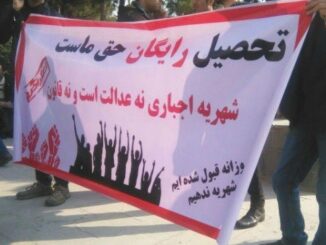
Student protests have expanded across the country against exam delays, the “definitive impact of GPA” rule, broken promises by education officials, and other damaging education policies.
On 22 June 2026, students protested in Ilam, Khorramabad, Shahrekord, Urmia, Kerman, Tehran, Yazd and Shiraz. On 23 June 2026, protests were also reported in Gorgan and Ahvaz, bringing the number of protesting cities to at least 10.
In Tehran, students gathered near Ferdowsi metro station and marched toward the Ministry of Education. In Shahrekord and Khorramabad, students gathered outside governorate buildings. In Ilam, they protested outside the education office. In Kerman, security forces intervened to stop the protest.
Families also joined some of the protests. These demonstrations are among the most important protest actions since the 39-day war.
Postgraduate students protest at Islamic Azad University
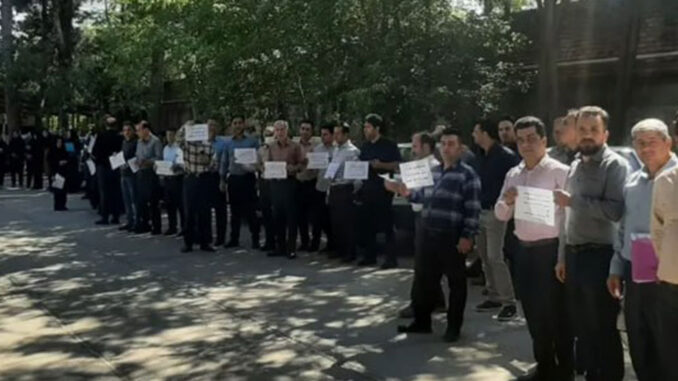
On 22 June 2026, master’s and PhD students at Islamic Azad University gathered outside the university’s central organisation to protest the sudden decision to make exams in-person.
Following the protest, officials announced that exams would be postponed for 20 days. However, the decision to make exams in-person was not cancelled. Students announced that if the decision is not withdrawn, protests will continue.
Tabriz machine manufacturing workers strike
On 23 June 2026, workers at Tabriz Machine Manufacturing went on strike over two months of unpaid wages. Around 1,600 workers at the factory have not received wages since May.
Under pressure from the workers’ protest, the labour commission at the East Azerbaijan governorate held a meeting. The workers are demanding a response to their demands and the immediate payment of their wage arrears.
Sarjin Baft factory shut down after workers protest
On 21 June 2026, afternoon-shift workers at the Sarjin Baft spinning unit in Zanjan held a protest over three months of unpaid wages and unpaid insurance contributions.
In response to the protest, the employer shut down the entire company, claiming that it had no financial capacity and that the factory’s funds were at zero. The workers’ protest continues, and they are demanding their rights and unpaid wages.
War-affected families forcibly evicted from hotels
According to reports, since the middle of last week and during the final week of June, municipal officials announced that the temporary hotel stays of people affected by the war had ended and that they had to vacate their rooms within 12 to 24 hours.
Following this decision, lunch and dinner allocations for these people were cut from the previous week, their entry cards were deactivated, and some of those with nowhere to live were forced to spend the entire day and night in hotel courtyards or on the streets.
Many war-affected people in Tehran, who had been moved to hotels in the capital from the first week of March because their homes had been destroyed, now have nowhere to live. Their homes remain uninhabitable, and some had not yet received housing deposit loans or assistance from the municipality to buy basic household items. They are now being forced out of the hotels under eviction orders.
During the war, the Islamic Republic stationed its military forces in many residential areas, using people’s lives as human shields. The government is responsible for these people and must pay war damages and provide them with suitable housing.
Sharif university students and graduates protest expulsions
More than 1,000 students and graduates of Sharif University of Technology signed an open letter to the university president protesting the growing number of disciplinary cases, suspensions and expulsions.
The letter condemns at least 30 disciplinary cases and preliminary and final expulsion rulings issued in recent months. The signatories demand the resignation of the university management.
Teachers condemn poverty and educational deprivation
The Coordinating Council of Iranian Teachers’ Trade Associations issued a statement protesting the deepening livelihood crisis and the spread of educational deprivation.
The statement warns that the crisis is not only economic, but shows the gradual collapse of livelihood security for millions of families. It stresses that when families cannot meet basic needs, children are the first victims, and poverty and inequality are driving hundreds of thousands of children out of education.
The council’s urgent demands include immediate wage increases in line with real inflation and living costs, full implementation of government obligations toward teachers, workers, pensioners and nurses, increased public education funding, an end to the commodification of education, and recognition of independent organising.
Pensioners resume protests in several cities
On 21 June 2026, Social Security pensioners held protests in Ahvaz, Tehran, Mashhad, Shush, Arak and Dezful over soaring living costs and worsening conditions.
In Shush, pensioners from Karkheh, Haft Tappeh and Shush marched and rallied. In Tehran, pensioners gathered outside the Social Security Organisation and chanted against government looting, high prices and the destruction of healthcare.
Their demands include immediate payment of arrears, full wage equalisation, pensions above the 70-million-toman living basket, free healthcare, improved welfare services, an end to repression and imprisonment, and an end to the regime’s war policies and looting.
Telecommunications pensioners also resumed protests in Sanandaj, Tehran and Ahvaz, protesting low pensions, lack of free healthcare, broken promises, unpaid arrears, incomplete implementation of regulation 24/89, chaotic supplementary insurance, and looting by major shareholders linked to the regime and the IRGC.
Workers strike and protest over unpaid wages and job insecurity
On 21 June 2026, workers, truckers and drivers at Tazareh Coal Mine in Eastern Alborz went on a united strike over millions in unpaid wages dating back to March. They completely halted the flow of freight.
On the same day, workers at Behesht Zahra in Tehran, including grave-digging and green-space workers, stopped work and gathered outside management to protest the removal or reduction of wage benefits, including overtime, holiday pay, leave payments and other benefits.
Their demands include the immediate restoration of wage benefits, an end to job threats, better conditions for contract workers, recognition of the hardship of their work, and an end to the wage gap.
Health and medical workers protest
On 22 June 2026, personnel at the Islamabad-e Gharb Health Centre protested over poor wages, benefits and worsening living conditions.
On 21 June 2026, staff at Kermanshah University of Medical Sciences again gathered outside the governor’s office to protest a 20% wage increase coefficient, which they say is far below what is needed under current living conditions.
Artists and women’s rights activists condemn flogging sentence against parastoo ahmadi
On 21 June 2026, during a memorial event in Tehran for American ethnomusicologist Stephen Blum, prominent Iranian composer Hossein Alizadeh condemned the flogging sentences issued against those involved in the “Caravanserai Concert,” saying society is witnessing “the Stone Age.”
Singer Googoosh also condemned the sentence against Parastoo Ahmadi and eight musicians and organisers of the concert: 74 lashes, a two-year travel ban, and two years of deprivation from artistic activity.
The organisation Neday-e Zanan-e Iran also condemned the sentence and called for broad support for Parastoo Ahmadi and the right of women to sing and participate freely in public life.
Defending Parastoo Ahmadi and the Caravanserai Orchestra is a protest against the entire system of sexual apartheid and medieval rule.
Masoud Farhikhteh refuses to attend regime court
Masoud Farhikhteh, a protesting teacher imprisoned in Karaj Central Prison, is facing a new case. He is due to be tried on 28 June 2026 in Branch 2 of the Karaj Revolutionary Court on charges of “propaganda against the system.”
In an audio message from prison, he announced that he will not attend the court session.
Farhikhteh has been serving a sentence of three years, six months and one day since 16 September 2025, following confirmation of his earlier sentence by the Alborz appeals court.
People in Shiraz force withdrawal over waste site
Residents near Takht-e Jamshid Boulevard in Shiraz protested the establishment of a waste transfer and sorting site near their residential area, citing serious health and environmental problems.
Following widespread local protest, authorities were forced to retreat. The deputy for human environment at the Fars Environmental Protection Department announced that the issued permits for the site had been revoked and that no activity should take place there under current conditions.
A society in motion
Across Iran, protests by prisoners, students, workers, pensioners, teachers, healthcare staff, artists, war-affected families and local communities are widening.
The central message is clear: the Islamic Republic is not the representative of the people of Iran. The future of society will be decided by the people’s struggle for freedom, equality, dignity and the overthrow of the regime.
Worker-communist Party of Iran
23 June 2026