
24 March 2026
Memorial gatherings for victims held across the country
“Tuesdays Against Execution” continues in 56 prisons
Despite wartime conditions, the “Tuesdays Against Execution” campaign marked its 113th week today, taking place in 56 prisons across Iran. Throughout the weeks of war and heightened repression, this campaign has remained an important front of protest against executions.
In its weekly statement, the campaign welcomed the arrival of Nowruz 1405 while drawing attention to the execution of more than 2,650 prisoners in the past year. Among those executed during the New Year period were Mehdi Ghasemi, Saeed Davoudi and Saleh Mohammadi, who were hanged in Qom, as well as Kourosh Keyvani, executed in Karaj Central Prison.
The statement calls for increased international pressure on the Islamic Republic to halt executions. It also highlights the ongoing torture and abuse of prisoners, including reports that dozens of prisoners were wounded and several killed in Chabahar prison during protests over food shortages and lack of medical care.
The campaign again demanded the immediate release of all political prisoners whose lives are in danger. In part, the statement reads:
“We express our sincere gratitude to all individuals, teachers’ organisations, pensioners, workers, the families of those sentenced to death, independent media and all those who have been the voice of prisoners facing execution. We hope that the year 1405 will be the year of freedom for Iran — an Iran without torture and executions.”
Memorial gatherings honour victims of the “Bloody January” uprising
Another important development in recent days has been memorial ceremonies for those killed during the Bloody January uprising, organised by families and attended by many members of the public. These gatherings have become a powerful symbol of the nationwide demand for justice for the victims of the regime’s repression.
On 21 March, in Abdanan, the family of Alireza Seidi, a 16-year-old killed during the January protests, gathered at his grave together with local residents. Music was played and people expressed their anger and grief while marking the New Year at the gravesite.
Alireza Seidi was shot and killed by security forces in Tehran on 8 January.
On 21 March, the family and friends of Mahan Rostami, another victim of the January uprising, gathered at his grave and marked the New Year by lighting a fire and setting a Nowruz table in his memory.
Public mourning for executed protester Saleh Mohammadi
On 19 March, Saleh Mohammadi, a 19-year-old wrestler and protest detainee, was executed by the Islamic Republic. A large crowd gathered at his grave in Qom, where people honoured his memory with music and applause.
Saleh was executed only one week after his 19th birthday. A promising young wrestler, he had hoped to one day compete in the Olympic Games. According to his relatives, he lived with hope, ambition and determination for the future.
During his trial, Saleh Mohammadi denied the accusations against him, stating that the confessions presented in court had been extracted under pressure.
Acts of solidarity during the New Year period
In Kerman, large gatherings of people seeking justice were also reported during the New Year period. One notable moment during these gatherings was the announcement of the formation of mutual aid groups to help one another under the current wartime conditions.
Memorial ceremonies were also held in Minab for children who lost their lives during recent US and Israeli attacks on Iran. Large numbers of people attended these gatherings to honour the memory of the children who were killed.
Across the country, people welcomed the New Year by visiting the families of victims and political prisoners, expressing solidarity and support.
Last Thursday of the year: a tradition of protest and remembrance
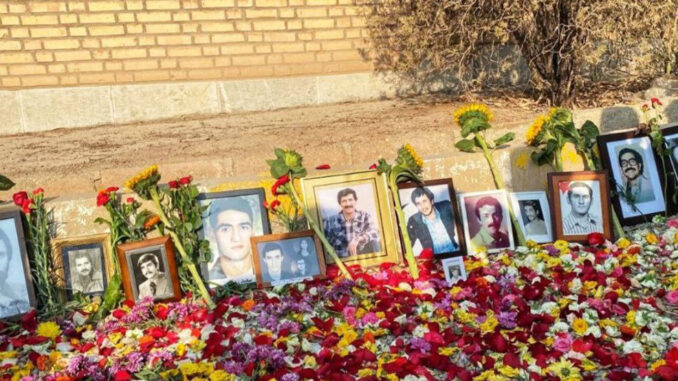
The last Thursday of the year has become an important day of collective solidarity. Every year, families of political prisoners gather outside prisons, setting a Nowruz “Haft-Seen” table, while families seeking justice gather at the graves of loved ones killed by the Islamic Republic.
This year, on 19 March, the Khavaran Mothers again attempted to visit the Khavaran cemetery. Although security forces prevented them from entering, their presence sent a powerful message of resistance and remembrance.
In Tehran, people gathered at the grave of Ali Bayat, another victim of the January uprising, playing music and expressing their protest and determination. On the same day, the family and friends of Sepehr Shokri, also killed during the uprising, gathered at his grave to honour his memory.
A message of resistance from society
The Islamic Republic has suffered major political blows—both from the people and through the war with the United States and Israel, which has resulted in the loss of Ali Khamenei and other senior officials, as well as heavy damage to its military apparatus.
This year’s Nowruz message from society to the regime is one of resilience and defiance. Through mutual aid networks, their loud calls for justice, and continued opposition to executions and imprisonment, people are signalling their determination to bring an end to the rule of this regime of repression and misery.
Worker-communist Party of Iran
24 March 2026


