After the war, is the Islamic Republic weaker than ever — or preparing for a new phase of repression?
With key leaders gone, its military damaged, the economy collapsing, and growing isolation in the region, the regime faces its most fragile moment in decades. But what does this mean for the people — and what comes next?
Is Iran heading toward stability, or a new wave of uprising?
Read the full analysis:
Interview with Hamid Taqvaee – 16 April 2026
International: How do you see the future of the Islamic Republic after this war? Specifically, if the regime is not overthrown during the war, how will the blows it has suffered—and the loss of its leaders—affect its position in relation to the people?
Hamid Taqvaee: As you pointed out, the elimination of Khamenei, Larijani, and other top figures has been a serious blow to the regime, but its problems go far beyond this. As a result of the war, the regime has been weakened more than ever in terms of factional infighting, internal disarray, military capacity, its regional position and relations with neighbouring governments, its economic crisis and collapse, and ultimately its position in its ongoing conflict with the people. It now stands on the brink of collapse. Mojtaba Khamenei, the not-yet-formally unveiled “leader,” lacks authority and is not even accepted by sections of the regime itself.
At the same time, the regime’s strategic identity—its anti-U.S. and anti-Israel policy, which was embodied by Khamenei—had already come under question in his final years, especially after Assad’s fall and the repeated setbacks of its proxy forces. With Khamenei gone, this policy has lost even more legitimacy among ruling circles. This deepens the long-standing paradox between anti-Westernism and the regime’s survival and pushes it toward a decisive turning point.
Another factor is the erosion of the regime’s military capacity, both in personnel and equipment. A layer of top commanders has been eliminated, military industries have suffered severe blows, and the regime’s air defence—whose only notable “achievement” was shooting down a civilian airliner in January 2020—has effectively lost its functionality. Rebuilding these losses, even if the ceasefire holds, would require time and resources the regime simply does not have.
Regionally, Arab governments—many of which previously had relatively normal or non-hostile relations with the Islamic Republic—have now turned against it. According to Anadolu Agency, during the 39-day war and even after the ceasefire, the Islamic Republic targeted the UAE, Jordan, Bahrain, Saudi Arabia, Oman, Qatar, and Kuwait with at least 6,413 missiles and drones, and in one case even with two fighter jets. These governments now see their own security and survival as tied to the overthrow of the regime in Iran. This further isolates and pressures the Islamic Republic. The closure of the Strait of Hormuz in the final week of the war has intensified this isolation both regionally and globally. The Strait issue has once again demonstrated that the Islamic Republic is intolerable and must be removed to ensure free navigation and prevent a deeper global economic crisis.
Economically, the war has dealt heavy blows to an already collapsing system. Inflation, unemployment, economic stagnation, currency devaluation, widespread poverty, water and electricity shortages, and environmental degradation—all of which had already pushed the economy toward collapse—have now worsened significantly. The result is a deepening economic crisis and a sharp deterioration in living conditions.
Basic food items such as dairy and meat have increased in price by up to 140%. Analysts warn that if current conditions continue, or even if a ceasefire is reached without a comprehensive agreement to lift sanctions, annual inflation could reach 120.5%, with point-to-point inflation rising to 141.3% by year’s end. This would mean a severe decline in household purchasing power and a widening class gap.
Another destructive economic factor is the 48-day internet shutdown—a direct result of the regime’s repressive policies. Its consequences go beyond information control and have intensified unemployment, economic stagnation, and insecurity. According to official figures, the internet shutdown costs $80 million per day, amounting to more than $3 billion so far. Much of this damage has fallen on millions of families who depend on the internet for their livelihoods. To this must be added direct war damage, as well as ongoing hardships such as shortages of water, electricity, gas, medicine, and essential goods, along with severe environmental pollution.
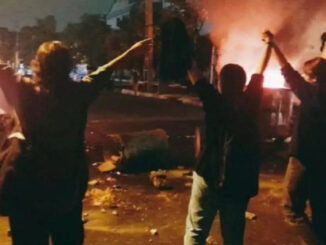
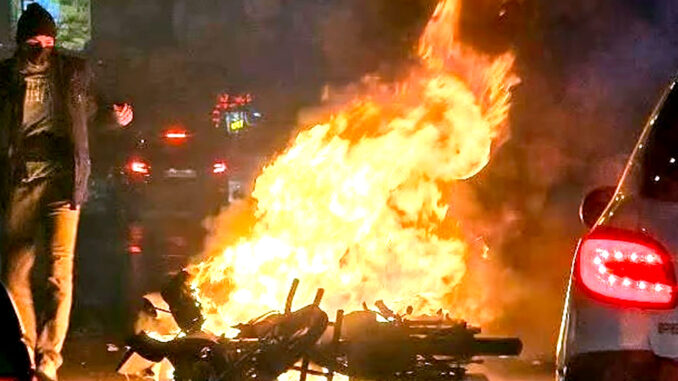
Society will not tolerate such conditions. After the 12-day war, economic pressure became so unbearable that it led to strikes by bazaar merchants, students, protests in Kurdistan, and millions taking to the streets across hundreds of cities. The regime responded with the bloody massacres of January 18–19 but failed to silence society. People turned funerals and memorials into protest gatherings. Even during the recent war, street celebrations following Khamenei’s death and the continuation of anti-execution protests showed that people have not forgotten that “the enemy is right here.”
People rightly hold the Islamic Republic and its war-driven policies responsible for all their hardships, including the damage caused by the war. Now, alongside long-standing struggles against unemployment, inflation, executions, mass arrests, and for the release of political prisoners, new demands—such as compensation for war damage, restoring internet access, and opposing the regime’s war policies—have been added to the agenda of the people, opposition parties, and protest movements emerging from the Woman, Life, Freedom movement. These are not just demands but arenas of struggle to overthrow the regime.
Whatever the outcome of the war and ceasefire, Iranian society is pregnant with a new, sweeping uprising. The mass killings of January could not suppress the protest movement, and the regime’s current weakened state will be even less capable of doing so.
16 April 2026