Teachers have called for a nationwide school closure on 18 February under the banner “For the empty desks, for the unfinished dreams,” honouring the children and educators killed in the crackdown. Memorial ceremonies across the country are drawing large crowds, with families openly demanding justice and chanting “Death to the dictator.” Alongside broader calls for work stoppages, these actions show a society that refuses to forget, refuses to retreat, and is turning mourning into organised resistance.
Teachers call for nationwide school closure on 18 February
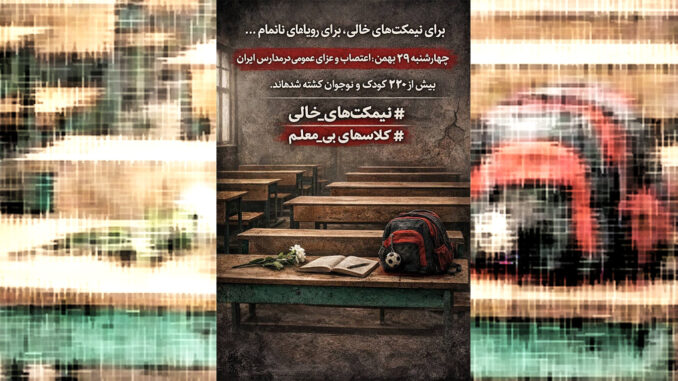
“For the empty desks, for the unfinished dreams”
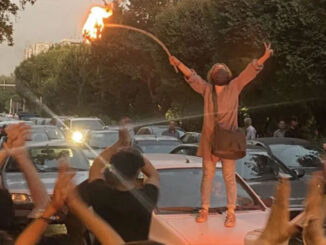
As the fortieth day since the January massacre approaches, commemorations, nightly rooftop chants of “Death to the dictator,” and calls for work stoppages on 17 and 18 February are spreading across Iran. Millions are forming a united front of justice against the Islamic Republic. Anger and determination continue to grow, with society openly declaring that no degree of repression will force it back.
On this occasion, the Coordinating Council of Teachers’ Trade Associations of Iran has issued a call titled “For the empty desks, for the unfinished dreams,” declaring Wednesday 18 February 2026 a day of public mourning, strike, and school closure.
The statement refers to the 230 children killed during the January crackdown and to teachers punished for “voicing the pain of students.” It states:
“They were not numbers. They had names, families, futures…
When a child is killed, society does not merely mourn; its future is executed…
We will not allow names to become numbers, and numbers to be forgotten.
Defending school is defending the future. The right to life comes before any expediency.”
The Council calls for:
- Teachers to refrain from attending schools and administrative offices on 18 February
- Families to keep children at home for safety and solidarity
- Broad public participation in fortieth-day memorial ceremonies
The statement concludes:
“We do not accept forgetting. We will turn the school into a field of struggle for the right to life.”
Broader Calls for Work Stoppage
Numerous organisations have called for closures and work stoppages around the fortieth day. In a joint statement, the Worker-communist Party of Iran and the Communist Party of Iran urged society to halt work, stand with justice-seeking families, and participate massively in commemorations.
Fortieth-Day Memorials Across Iran
Nearly forty days after the January massacre, memorial ceremonies continue nationwide. Families openly speak of overthrowing the regime. Large crowds and chants of “Death to the dictator” reflect an explosive social atmosphere.
16 February ceremonies included:
- Malekshahi – Commemoration of Mohammad Reza Karami (16), marked symbolically as a “wedding at the graveside,” accompanied by traditional music, transforming mourning into protest.
- Fooladshahr – Fortieth-day ceremony for Ali Salehpour.
- Nahavand (Hamadan) – Commemoration of Behnam Darvishi.
- Fardis (Karaj) – Ceremony for Amir Mohammad Najafi (30).
- Karaj – Memorial for Mehdi Sabri (22), with chants and symbolic celebratory gestures.
- Tehran – Ceremony for Ali-Mohammad Kord Kazemi (22).
- Isfahan – Memorial for Mohammad Javad Khalili Ardeli.
- Gorgan – Commemoration of Atena Hosseinian.
- Gonabad – At Hossein Ajam’s ceremony, his father declared:
“Hossein went to voice freedom and truth. They answered him with live bullets.”
The crowd responded: “Death to the dictator.”
- Songhor (Kermanshah province) – Authorities blocked gravesite gatherings, forcing families to hold indoor ceremonies for Bijan Mostafavi, Zahra Bani Ameri, and Danial Mostafavi.
- 15 February – Ceremony for Reza Asadi, with large attendance and chants: “A flower has fallen, a gift to the homeland.”
The widespread participation, defiant speeches, and nightly chants demonstrate a society that refuses silence. The fortieth day has become not only a moment of mourning, but a renewed declaration that the machinery of killing must end.
Worker-communist Party of Iran
16 February 2026